

Built for Factory Workforces
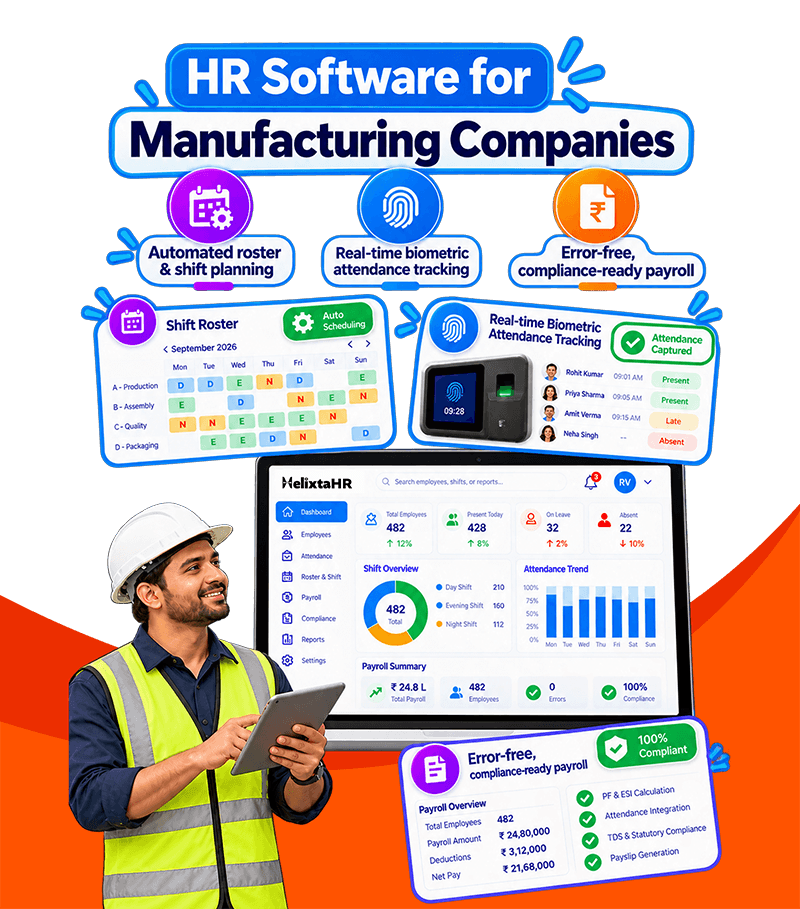
HR Software for Manufacturing Companies
Manage shifts, track attendance, run compliant payroll, and streamline workforce operations across factories and plants, all from one powerful platform.
- Automated roster & shift planning
- Real-time biometric attendance tracking
- Error-free, compliance-ready payroll
The Basics
What Is HR Software for Manufacturing Companies?
HR software is an offering used by manufacturing organizations to make employee administration more efficient — guaranteeing compliance with labour laws while facilitating payroll, shift systems, and everyday office attendance. The system provides advanced functionality to manage staff across multiple shifts, track overtime, and ensure adherence to labour regulations, all while automating processes that eliminate manual tasks and mistakes.
The Challenges
Key HR Challenges Faced by Manufacturing
We understand the real-world challenges you face in operating workforce activity on the production plant.
Complex Shift Management
Handling multiple shifts, rotating schedules, overtime work, and sudden absences that disrupt production planning.
Compliance & Safety Requirements
Continuous monitoring and accurate record-keeping to track labour laws and safety regulations.
High Workforce Turnover
Difficulty retaining skilled workers without proper systems for tracking, engagement, and monitoring.
Manual Time Tracking
Dependency on punch cards and spreadsheets creates attendance problems, payroll errors, and time theft.
The Solution
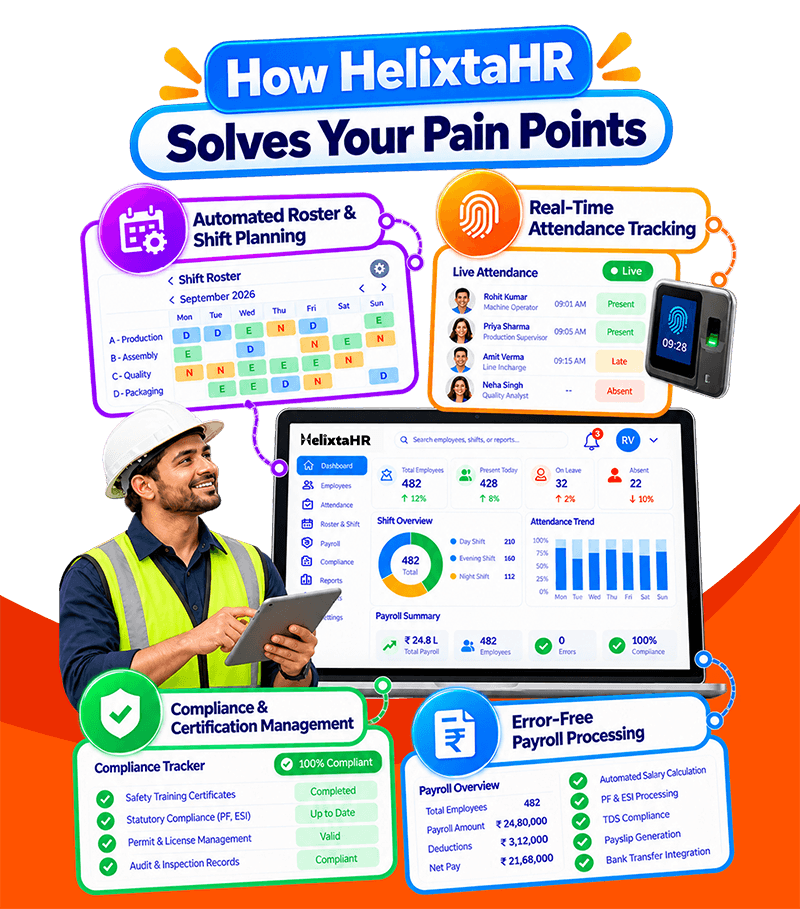
How HelixtaHR Solves Your Pain Points
A single system to handle all manufacturing personnel needs with precise, user-friendly functionality.
- Automated Roster & Shift Planning — Schedule rotating shifts and handle shift swaps while the system calculates overtime automatically.
- Real-Time Attendance Tracking — Track work hours accurately through biometric devices and geo-based mobile check-ins across multiple locations.
- Compliance & Certification Management — Stay compliant by monitoring safety training and regulatory requirements through automated alerts and record-keeping.
- Error-Free Payroll Processing — Automatically transfer attendance data to payroll, handling overtime, shift work and deductions with complete precision.
Real Results for Manufacturing Companies
With a fully automated HR system, manufacturing businesses achieve enhancements in operational efficiency, accuracy and workforce management.
40%+
Improvement in Workforce Efficiency
60%+
Reduction in Payroll Errors
50%+
Faster Shift & Attendance Management
70%+
Reduction in Administrative Work
Simplify Your HR Setup in 3 Easy Steps
Set up workforce management quickly without any complexity or delays.
01
Setup Your Organization
Add your company details, configure policies, and build departments, shifts, and workforce structure within minutes.
02
Onboard Your Workforce
Easily onboard new employees, assign roles, and connect through biometric or mobile tracking methods.
03
Start Managing Operations
Perform attendance tracking, payroll processing, shift management, and performance assessment all in one place.
Why It Matters
Why Manufacturing Companies Need Specialized HR Software
Manufacturing organizations face special difficulties which arise from managing a large and varied workforce. Rotational shifts require strict control over working hours, and attendance needs continuous monitoring. Many factories use contract workers, which creates difficulty in managing multiple employment contracts while maintaining consistent standards. Customized HR software addresses these challenges by streamlining payroll, tracking hours and simplifying shift management — while helping manufacturers meet strict employment law requirements.
On the Ground
HR Challenges Faced by Manufacturing Companies in India
The operational complexities and workforce demands of manufacturing companies in India create distinct HR difficulties which organizations must manage.
- Shift Management — Multiple, rotating, and night shifts create scheduling problems and worker fatigue.
- Overtime Tracking — Difficult to track accurately, leading to increased expenses and operational problems.
- Contract Workforce Management — Payment systems, work regulations and benefits differ across contract types.
- Compliance & Audit Readiness — Maintaining precise records for labour, payroll, and audit needs takes significant manual effort.
- Scalability Issues — Growing headcount makes it harder to monitor attendance, performance, and operations.
Core Modules
Attendance & Shift Management for Factory Workforce
Effective attendance management enables smooth operations while maintaining compliance with regulatory requirements.
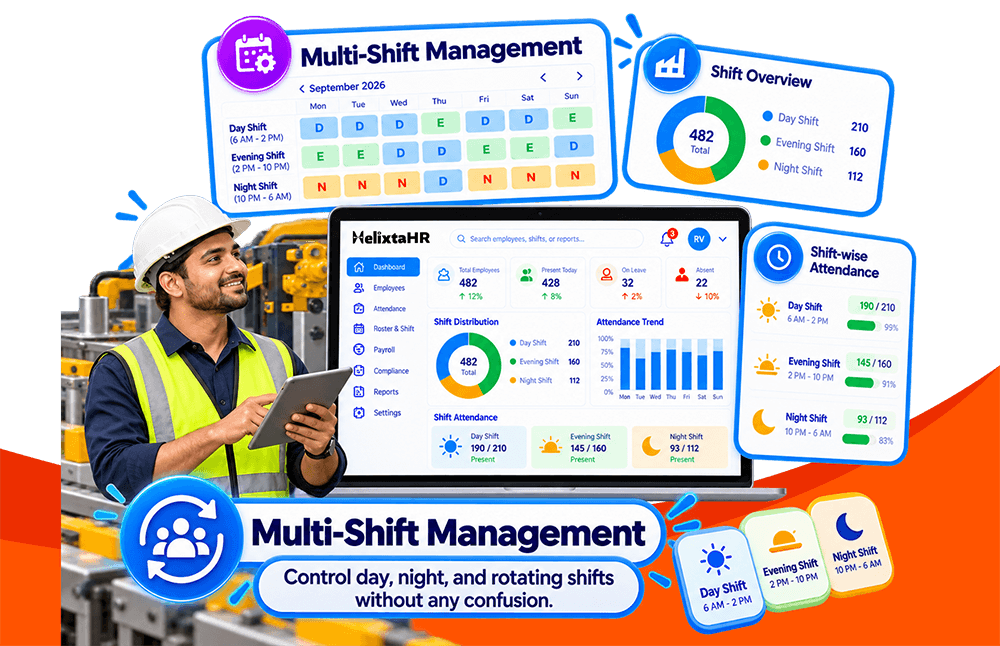
Multi-Shift Management
Control day, night, and rotating shifts without any confusion.
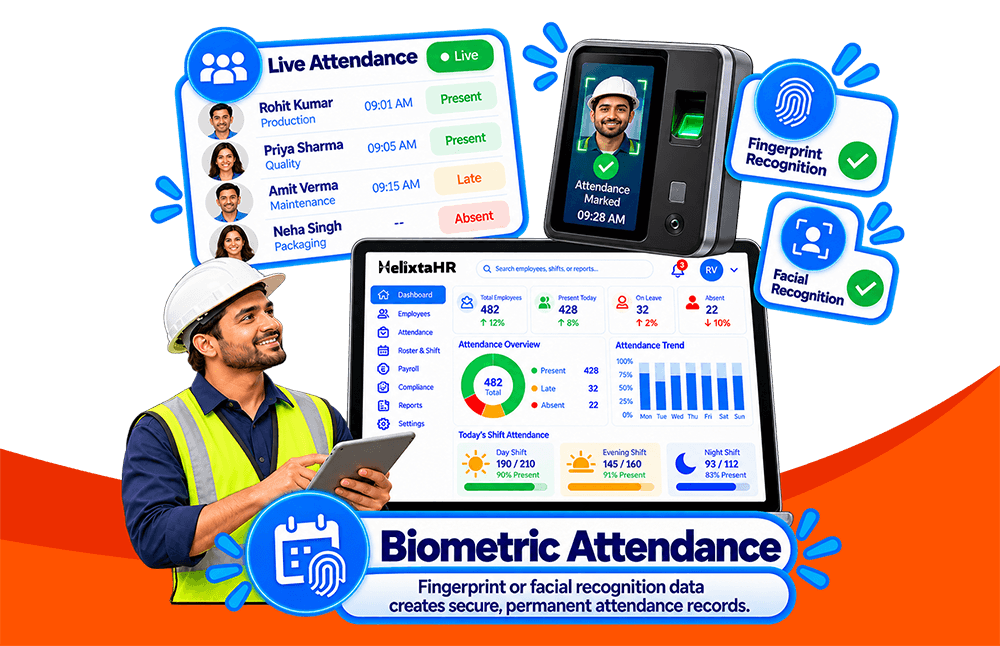
Biometric Attendance
Fingerprint or facial recognition data creates secure, permanent attendance records.
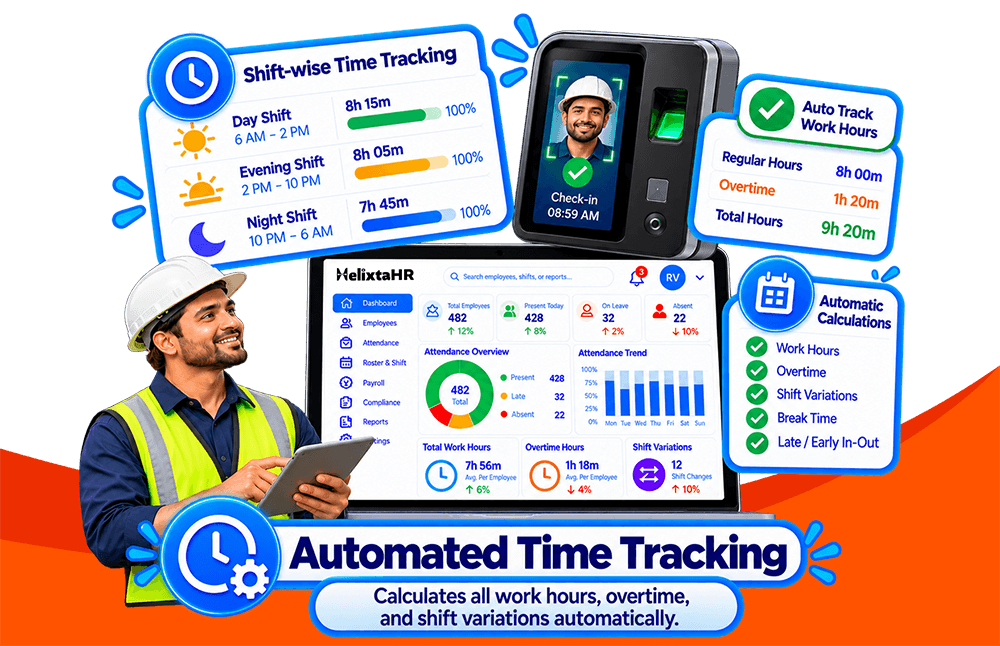
Automated Time Tracking
Calculates all work hours, overtime, and shift variations automatically.
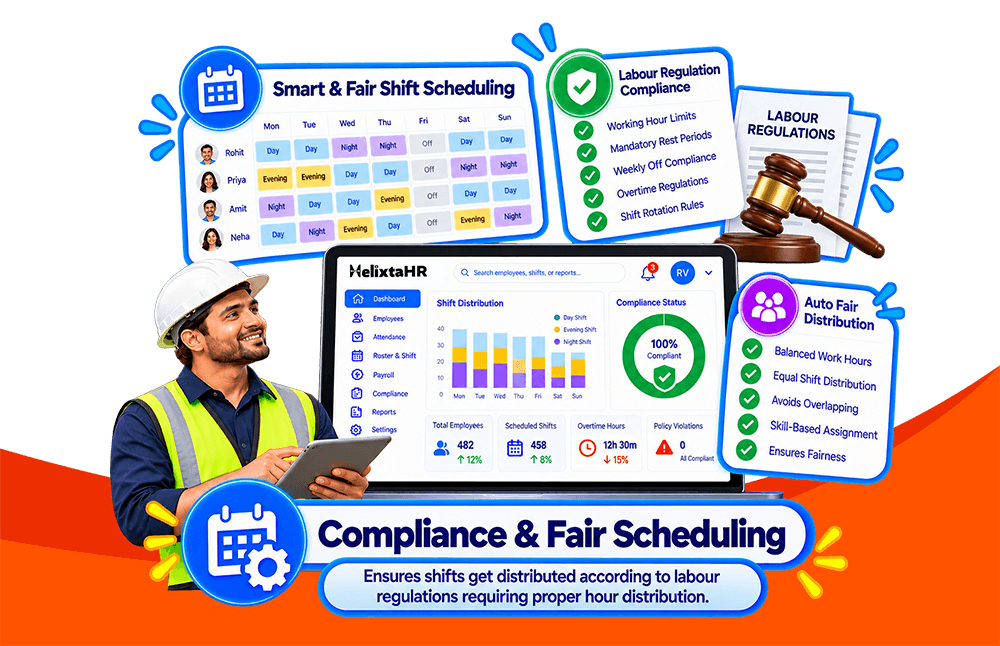
Compliance & Fair Scheduling
Ensures shifts get distributed according to labour regulations requiring proper hour distribution.
Payroll
Payroll & Statutory Compliance for Manufacturing Units
Precise Wage Calculation
- Base pay, overtime, and shift differentials
- Performance bonuses included accurately
- Minimum wage and work-hour compliance
Statutory Deductions
- PF, ESI, and professional tax handled correctly
- Reduces legal and compliance risk
- Full audit-ready documentation
Onboarding & Workforce Records
- Bulk onboarding for multiple staff at once
- Accurate, secure record storage
- Connected to attendance and shift data
Comparison
HR Software for Manufacturing vs Generic HR Tools
Here are certain examples to justify the difference.
| Feature | HR Software for Manufacturing | Generic HR Software |
|---|---|---|
| Shift Management | Optimized for complex shift schedules and overtime for factory workers | Basic scheduling with limited shift-based features |
| Compliance | Tailored for industry-specific regulations, labor laws and safety standards | General compliance tools, may not address industry-specific needs |
| Scalability | Designed to scale with growing operations, handling large, shift-based workforces | Scalable but may lack manufacturing-specific scaling features |
| Workforce Types | Manages factory and contract-based labor with specialized payroll functions | Suitable for standard employee types, may struggle with shift/contract work |
Choose your pricing plan
As per your needs, without any risk
- No contractual lock-in period. Zero obligations.
- No hefty hidden or maintenance charges.
- Transparent pricing, built for real business needs.
Right-Sized
HR Software for Every Manufacturing Business Size
Small Manufacturing Businesses
- Affordable, cost-effective pricing
- No dedicated HR team needed
- Simple attendance, payroll and records
Mid-Size Manufacturing Businesses
- Automated workflows and detailed reporting
- System connection capabilities
- Grows with expanding operations
Large Manufacturing Industries
- Multi-location integration and oversight
- Automated compliance reporting
- Employee self-service portals
AI-Powered HRMS
How Manufacturing HR Operations Are Supported by HelixtaHR
HelixtaHR automates intricate HR duties while guaranteeing seamless operations, with a focus on shift management, India-specific compliance, and easy integration of payroll, attendance, and HR — reducing manual work and improving operational effectiveness.
Book A Demo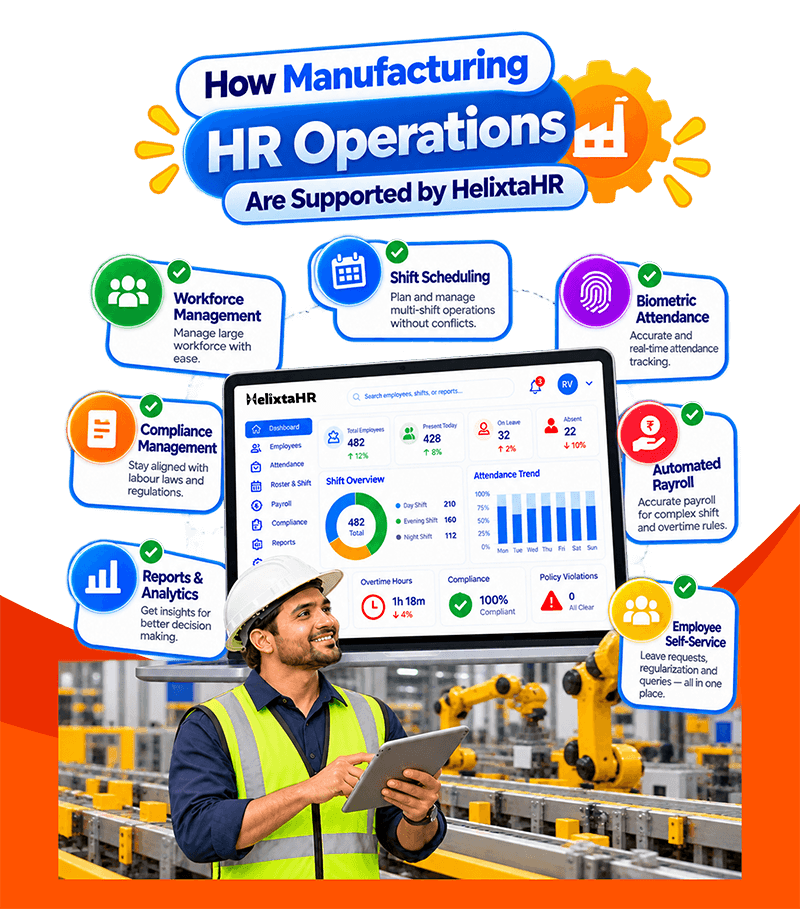
Buyer's Checklist
How to Choose the Best HR Software for Manufacturing
Consider these factors to support your operations and guarantee seamless workforce administration.
Adherence with Local & National Laws
India-specific compliance covering salary payment, working hour limits, and safety standards.
Work Scheduling & Attendance
For factory environments, identify software with strong shift scheduling capabilities.
Software Integration Capabilities
Integrating recruiting, payroll and attendance minimizes mistakes and boosts efficiency.
Self-Service Portals
Reduce HR department workload with portals where employees check payroll, attendance, and benefits.
Scalability
Ensure the software scales with your business as employee count or production levels grow.
Testimonials
Real Results. Real Businesses. Real Impact.
500+ organizations across India trust HelixtaHR to run payroll, attendance and compliance every month.

Harish Kulkarni
HelixtaHR has been a game-changer for us. Managing shift schedules for our production floor workers used to be a manual nightmare. Now, shift creation, rotation management, and overtime tracking are fully automated. Payroll is processed without a single error.

Rekha Patil
We manage a large workforce across assembly lines and support departments. HelixtaHR handles shift-based attendance, contractor compliance, and statutory deductions like PF and ESIC seamlessly. Purpose-built for manufacturing!

Sudhir Thosar
Our energy manufacturing unit at Shree Prarambha has diverse teams working in rotating shifts across multiple sites. HelixtaHR has streamlined everything. PF and ESIC compliance is automated, and our audit readiness has improved dramatically.

Santosh Ghosalkar
HelixtaHR gave Manu Electricals the operational HR control we were missing. The system handles complex shift patterns, auto-calculates LOP, and syncs attendance directly to payroll. We've reduced payroll processing time by over 70%.

Nandini Wankhede
We use it for shift allocation, worker productivity tracking, and statutory compliance. The automated PF, ESIC, and PT deductions have eliminated our compliance headaches. A must-have for Indian manufacturers!

Vikram Deshmukh
Running a motor manufacturing unit means constant shift changes and heavy contractor dependency. HelixtaHR automated our entire attendance-to-payroll cycle. What used to take a full week now takes a day.

Priya Nair
Factovision runs multiple production shifts across our units, and tracking overtime and late clock-ins was always a struggle. HelixtaHR's biometric integration and auto shift-rotation feature fixed that instantly.

Rajendra Yadav
We manufacture electrical components with a large blue-collar workforce, and statutory compliance used to eat up most of our HR bandwidth. HelixtaHR automates PF, ESIC, and PT deductions end-to-end.
Ashwini Kulkarni
Hydro Gen Next has field and plant staff working rotating shifts across sites. HelixtaHR's mobile app lets our site supervisors mark attendance and approve leave on the spot.
Suresh Bhandari
Bajaj Sanitation has a mix of factory workers and field service teams, so our attendance needs are complex. HelixtaHR handles shift-based attendance, contractor compliance, and payroll processing without manual intervention.

FAQs
Frequently Asked Questions
HR software for manufacturing businesses works as a platform which helps companies handle their HR operations through solutions for payroll processing, attendance tracking, shift planning and employee performance evaluation.
Manufacturing organizations require specialized HR software to handle shift work monitoring, labor expense auditing, safety compliance management and high staff turnover control.
Yes, HR software uses automatic shift scheduling tools and accurate working hour tracking to monitor employee time and overtime, decreasing mistakes and protecting compliance with labor laws.
Yes — it automates payroll, attendance tracking and employee record management, saving time and decreasing manual tasks while helping the business expand.
Yes. HR software tracks attendance, working hours, and wages for both contract and shop-floor workers, enabling precise payment processing and improved workforce management.
HR software maintains compliance through automatic monitoring which checks conformity with labor laws, safety standards and wage regulations, streamlining record-keeping for audits.
Set Up and Manage Your Workforce Effortlessly
From setup to execution, take control of your workforce, reduce errors, and manage everything effortlessly in no time with our reliable HR solution for manufacturing.
Book Free Demo