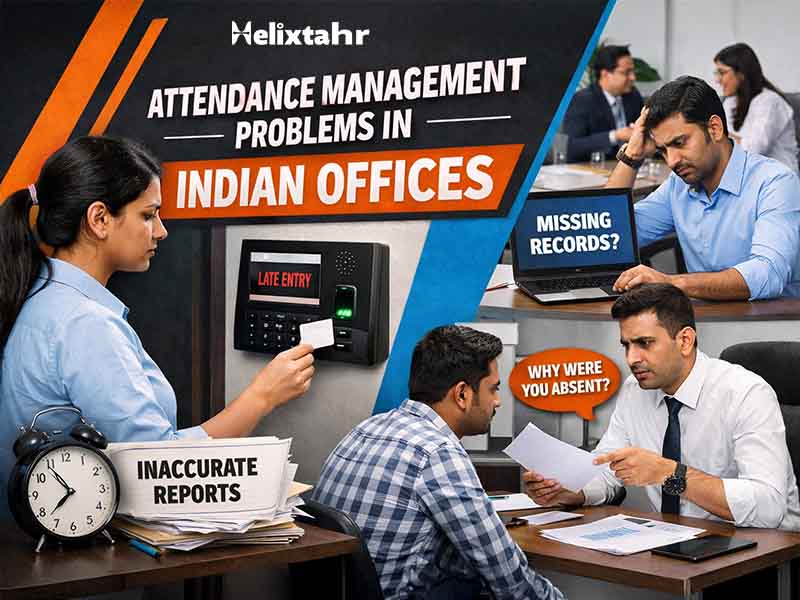
TL;DR:
- Late coming in Indian offices: Often caused by traffic and transport realities—not employee irresponsibility.
- Buddy punching (proxy attendance): Persists despite biometric systems due to system design flaws.
- Biometric machines create bottlenecks: Long queues, fingerprint failures, power outages, and maintenance issues.
- Field sales tracking remains nearly impossible: No office means no punch with traditional methods.
- Regularization requests: Flood HR inboxes, turning exceptions into exhausting norms.
- Hybrid work broke legacy attendance systems: Entirely disrupting old models.
- Core insight: These aren’t people problems—they’re process problems.
- Solution direction: Mobile-first, geo-fenced, selfie-verified attendance systems designed for Indian workplace realities.
It’s 9:47 AM. Your biometric queue stretches to the parking lot. Three field sales reps claim “network issues.” Someone definitely marked attendance for their friend. And your inbox? Already flooded with regularization requests before your first chai.
If this sounds like your Monday morning, you’re not alone.
Attendance management problems in Indian offices aren’t new—but they’ve evolved into something traditional systems simply cannot handle. From Mumbai’s unpredictable local trains to Bangalore’s notorious traffic jams, from field sales teams working at remote distributor points to the infamous buddy punching culture, Indian HR managers face challenges that no global HRMS playbook prepared them for.
Here’s the uncomfortable truth most vendors won’t tell you: Employee attendance problems in India aren’t about lazy or irresponsible people. They’re about broken processes trying to manage a uniquely complex workforce reality.
This blog won’t lecture you about stricter discipline policies. Instead, let’s validate what you already experience daily—and explore why your attendance headaches might finally have a modern answer.
The 9 AM Chaos: Why Indian Employees Are “Always Late”
Let’s address the elephant in the room. Late coming employees are a problem in India, but not for the reasons most assume.
Consider the Mumbai HR manager whose team depends on Western Railway locals. A 15-minute delay isn’t an exception—it’s Tuesday. Or the Bangalore employee who left home at 7:30 AM for a 9 AM shift, only to spend 90 minutes crawling through Silk Board junction. Or the Delhi professional whose Metro broke down for the third time this month.
Transport delays affecting employee attendance in Indian cities aren’t excuses. They’re systemic realities that rigid punch-time policies simply cannot accommodate.
The result? HR spends mornings fielding “I’m stuck in traffic” calls, managers reluctantly approve grace period extensions, and resentment builds on all sides. Employees feel punished for circumstances beyond their control. HR feels like the bad guy enforcing impossible standards.
Here’s what nobody admits openly: Blaming employees for late coming doesn’t solve late coming. It just creates conflict while the actual problem—an inflexible attendance system — remains untouched.
The Field Force Nightmare: Tracking Employees Without an Office
If tracking office employees is difficult, tracking field staff is nearly impossible with traditional methods.
Ask any HR manager handling FMCG distribution, pharmaceutical sales, or construction projects. Their field sales attendance tracking challenges in India are unique. These employees have no office to “attend.” Their workplace is a distributor’s shop in Tier-3 Rajasthan, a chemist in rural Maharashtra, or a construction site with zero connectivity.
The traditional solution—”first call reporting” via phone—is laughably easy to manipulate. The employee calls from home, claims they’re at the client location, and nobody can verify otherwise. Some companies tried GPS tracking, only to discover employees using fake location apps to spoof their position.
Remote site attendance marking problems multiply when you add India-specific factors: patchy mobile networks, smartphone limitations among certain worker categories, and the sheer geographical spread of operations.
The current workaround? Field managers manually vouching for their teams, leading to either buddy-buddy inflation of attendance or genuine employees being questioned unfairly. Neither outcome serves the organization.
Is your attendance system ready for the future?
Don’t wait for the next HR headache. Take the first step towards an efficient, modern attendance system today.
Request a DemoBuddy Punching: India’s Open Secret in Attendance Fraud
Let’s talk about the problem everyone knows exists but few discuss openly: proxy attendance marking in Indian offices.
Buddy punching—where one employee marks attendance for another—was supposed to die with biometric systems. It didn’t. It simply evolved.
In manufacturing units, workers have figured out silicone fingerprint moulds. In offices, the security guard looks the other way when someone swipes two cards. In night shifts, an entire “attendance syndicate” operates where early leavers cover for those arriving late.
The buddy punching problem in Indian offices isn’t just about dishonest employees. It’s about systems that create opportunities for dishonesty. When your biometric machine has a 20-minute queue, when your attendance policy is inflexible, when regularization requests take weeks to process—employees find shortcuts.
The real cost isn’t moral. It’s financial. Inaccurate attendance means inflated payroll, unfair treatment of honest employees, and compliance headaches during audits. Yet most organizations treat it as a “values problem” rather than a “systems problem.”
When Biometric Attendance Becomes the Bottleneck
A decade ago, biometric attendance systems were the answer to all attendance management problems. Today, they’re often the problem.
Consider what happens at a typical Indian factory gate at 8:55 AM. Three hundred workers need to punch in before the 9 AM shift. Two biometric machines are functional (the third has been “under repair” for six months). Each punch takes 8-10 seconds. Do the math—it’s physically impossible.
Biometric attendance failure reasons in Indian offices go beyond queue management. Fingerprint recognition fails for workers with worn fingertips—common in manufacturing, construction, and agriculture. Humidity in coastal cities damages sensors. Power outages in industrial areas make machines useless precisely when they’re needed. The monsoon season brings its own connectivity chaos.
For government offices using the Aadhaar Enabled Biometric Attendance System (AEBAS), issues compound further. Server downtime, authentication failures, and poor rural infrastructure have made AEBAS implementation a case study in good intentions meeting ground realities.
The irony is painful: Organizations invested lakhs in biometric systems to solve attendance problems, only to create new categories of attendance problems.
The Regularization Avalanche Every HR Dreads
If you’re an HR manager in India, you know the regularization nightmare intimately.
Attendance regularization requests—manual corrections for missed or failed punches—were meant to be exceptions. They’ve become the norm. “My fingerprint didn’t register.” “The machine was down.” “I forgot to punch out.” “System showed me absent but I was in a client meeting.”
Fifty such requests per month is considered light. Some organizations process hundreds.
Each request requires employee explanation, manager verification, HR approval, and system correction. The email trails are endless. The manager approvals get stuck for weeks. Month-end payroll processing becomes a firefighting exercise. And somewhere in this chaos, genuine errors get mixed with deliberate manipulation.
Attendance regularization problems for HR in India expose a fundamental truth: When your exceptions outnumber your normal transactions, your system is broken. You’re not managing attendance anymore. You’re managing attendance failures.
Hybrid Work Broke Whatever System You Had Left
Then came COVID. And hybrid work. And whatever attendance system you had officially collapsed.
Work from home attendance tracking in India became a new headache overnight. Is the employee working or just online? Do video calls count as attendance? How do you treat someone who works 10 hours from home versus someone who shows up at office for 6 hours?
Hybrid work attendance challenges in Indian companies aren’t just logistical. They’re cultural. Resentment brews between employees who commute daily and those enjoying WFH flexibility. The “fairness” question haunts every policy decision.
Most organizations responded with makeshift solutions: screenshot submissions, hourly check-ins, always-on cameras. These created surveillance cultures without solving the actual problem. Employees felt mistrusted. HR felt overwhelmed. Nobody won.
The Real Problem: You’re Fighting People When You Should Be Fixing Process
Step back from the daily chaos and a pattern emerges.
Every attendance problem we’ve discussed—late coming, buddy punching, biometric failures, regularization overload, hybrid tracking—shares a common root cause. These aren’t people problems. They’re process problems wearing people-problem disguises.
Your employees aren’t late because they’re irresponsible. They’re late because your system can’t accommodate Indian traffic realities. Your field staff aren’t dishonest. They’re untracked because your system wasn’t designed for their reality. Your regularization inbox isn’t flooded because employees are difficult. It’s flooded because your attendance capture mechanism fails too often.
The moment you reframe “discipline problems” as “design problems,” solutions become visible.
What a Modern Attendance Solution Actually Looks Like
Modern attendance systems for Indian companies aren’t about better biometric machines. They’re about fundamentally rethinking how attendance works.
Mobile-first attendance makes sense because employees already carry smartphones. GPS tracking with geo-fencing allows location verification without hardware installation. Selfie-based authentication eliminates buddy punching entirely—you can’t take someone else’s selfie. Offline capability ensures attendance capture even without network connectivity, syncing when connection returns.
Most importantly, automated regularization workflows with manager notifications reduce that email avalanche to a manageable trickle.
The shift isn’t just technological. It’s philosophical. Instead of forcing employees to adapt to rigid systems, modern solutions adapt to how Indian workplaces actually function—with field staff, multiple locations, unpredictable commutes, and hybrid arrangements.
Conclusion
The attendance management problems in Indian offices won’t disappear with stricter policies or more expensive biometric machines. They’ll persist until organizations recognize a simple truth: The problem isn’t your people. It’s your process.
Your field sales team cannot punch a biometric machine from a distributor’s shop in rural India. Your software team cannot track hybrid work with paper registers. Your HR team cannot sustainably process hundreds of regularization requests without errors or burnout. HR Software will help you to do that.
The shift required is fundamental. Stop treating attendance as a discipline problem requiring enforcement. Start treating it as a design problem requiring modern solutions—mobile-first, geo-fenced, selfie-verified, offline-capable systems built for Indian workplace realities.
The question isn’t whether your attendance system needs to change. It’s whether you’ll keep fighting your people or finally fix your process.
The choice, and the opportunity, is yours.
Ready to see what modern attendance management looks like for your organization?
Request a DemoFrequently Asked Question
The most common issues include late coming due to traffic and transport challenges, buddy punching, biometric machine failures, excessive regularization requests, and hybrid work tracking difficulties.
Buddy punching can be effectively eliminated using geo-fenced mobile attendance apps with selfie verification, making it impossible for one employee to mark attendance for another.
Common failure reasons include sweaty or worn fingerprints, humidity damaging sensors, power outages, long morning queues, and poor hardware maintenance.
Regularization is the process of correcting missed or incorrect punches. It becomes problematic when HR receives hundreds of manual requests monthly, causing payroll delays and audit risks.
For organizations with field staff, multiple locations, or hybrid work policies, mobile attendance with geo-fencing typically offers more flexibility and reliability than fixed biometric hardware.