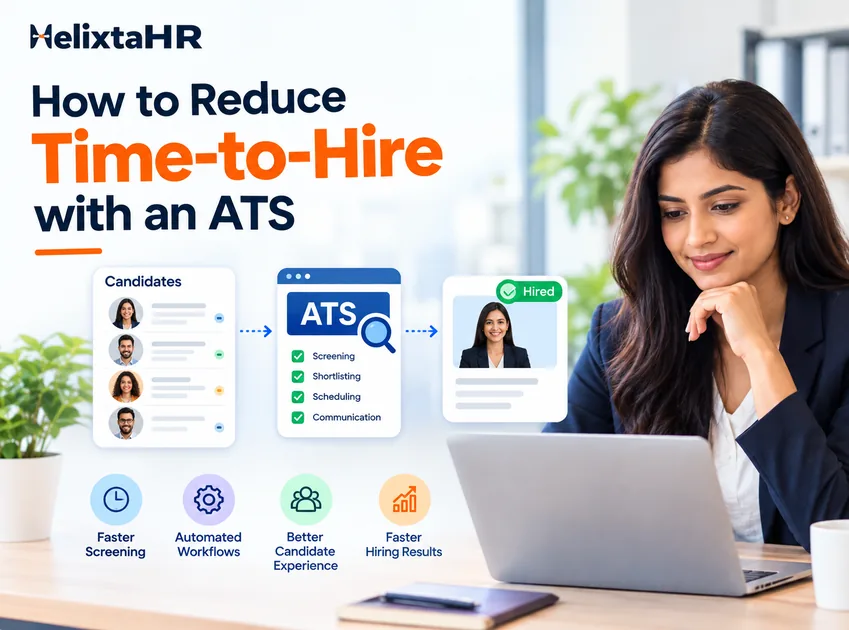
Every day a role sits open costs something — lost productivity, an overworked team covering the gap, sometimes a good candidate who simply can’t wait around. For Indian SMBs specifically, this pressure has gotten sharper lately, not lighter, even as hiring volumes pick up. This guide looks at what’s actually driving slow hiring right now, and how an applicant tracking system, paired with the right recruitment software, closes that gap.
What Time-to-Hire Actually Means, and Why It’s Getting Harder to Control
Still juggling HR across spreadsheets and emails?
HelixTAHR brings payroll, leave, attendance, and employee records onto one platform – built for indian businesses, compliant by default.
Time-to-hire is simply the number of days between a job going live and a candidate accepting the offer. Sounds straightforward, but the number hides a lot of moving parts — screening, scheduling, interview rounds, approvals, and the inevitable stretch where a candidate goes quiet for a few days before responding.
How Long Is Hiring Actually Taking Indian SMBs Right Now
As per recent industry figures, it takes about 30-45 days on average for India to hire an employee in the majority of the industries, but IT jobs get hired within a period of 25-35 days because there is a standardized process of hiring, whereas some specialized or senior-level positions might take up to 60 days or even more. In a different study that segregates the period of hiring based on the organization’s size, SMBs take about 46 days on average, whereas larger firms take around 35 days.
That gap matters more than it looks. Top candidates typically go off the market within about 10 days of becoming available, and industry surveys show roughly 61 percent of candidates accept the very first offer they receive. If an SMB’s process is still running at 45 days while a competitor closes in 20, the maths on losing good candidates isn’t complicated.
Where Manual Hiring Habits Quietly Slow Everything Down
Most SMBs aren’t slow because they’re careless. They’re slow because hiring is still stitched together manually across too many disconnected steps.
- Resumes sitting across three different inboxes, with no single place to actually see them all
- Screening done by reading through every application by hand, even the ones that were never a fit
- Interview scheduling handled through email chains that take days to land on a date
- No clear record of where a candidate actually stands, so follow-ups get missed or duplicated
- Feedback shared verbally after an interview, then half-forgotten by the time a decision needs making
Individually, none of these feel like a crisis. Together, they’re exactly what stretches a 20-day hiring process into a 45-day one.
What an Applicant Tracking System Actually Fixes
An applicant tracking system, or ATS, is built specifically to remove these gaps rather than just digitise them. Industry data on ATS adoption backs this up clearly — organisations using a proper ATS report time-to-hire reductions of 30 to 40 percent on average, with some seeing their overall hiring cycle shrink by as much as 60 percent. Separate recruiter surveys found that more than 86 percent of recruiters using an ATS said it directly reduced their time-to-hire.
The mechanism behind this is fairly straightforward. An ATS brings all the applications together in one place, where the initial screening process can be automated based on the requirements of the position. The status of each applicant is always kept visible within the system without the need for inquiries from other people. Scheduling interviews takes place through the system rather than via emails, and status updates are automatically sent out.
Recruitment Software Features That Directly Cut Time-to-Hire
Not every tool marketed as recruitment software actually moves the needle on time-to-hire. A few specific capabilities matter more than the rest.
- Automated resume screening, filtering out clearly unqualified applications before a recruiter ever opens them
- Built-in interview scheduling, removing the days lost to email back-and-forth over a single time slot
- A visible candidate pipeline, showing exactly who’s at which stage without anyone chasing an update
- Automated candidate communication, so updates go out consistently instead of getting forgotten mid-process
- Centralised feedback capture, so interview notes don’t get lost between the interview and the final decision
An SMB checking for these specific features, rather than just a long feature list, tends to see the time-to-hire improvement show up within the first hiring cycle or two.
How HR Recruitment Software Connects Hiring to the Rest of HR
Recruitment rarely stands on its own once someone’s actually hired. The same details collected during hiring — documents, offer terms, role information — need to move into onboarding and eventually payroll software, without someone re-entering the same information twice. When recruitment software sits apart from the rest of HR software, that handoff becomes yet another manual step, often the one that delays a new hire’s first payslip or access setup.
This is also where attendance software enters the picture indirectly. A faster, better-organised hiring process means new hires start on time, with their attendance and payroll setup ready from day one instead of catching up over their first two weeks on the job.
How HelixtaHR Helps Indian SMBs Reduce Time-to-Hire
The recruitment process in HelixtaHR is included in the same platform as the onboarding, attendance, and payroll process instead of being used as an additional tool that needs to be added separately. The whole process of applications, screening, and interviewing of candidates is performed within one system instead of having recruiters handle spreadsheets next to email. Once someone’s hired, their information carries straight through into onboarding and payroll, without anyone typing the same details in twice.
For SMBs specifically, where there’s rarely a dedicated recruiter working full-time on hiring, this connected setup matters more than it might for a larger company with a full talent acquisition team. It’s the difference between hiring competing with everything else on someone’s plate, and hiring actually running on its own in the background.
A Simple Framework SMBs Can Use to Track and Improve Time-to-Hire
Reducing time-to-hire isn’t about one big fix — it’s about measuring the right things consistently.
- Track time-to-hire as a standard metric, measured from job posting to offer acceptance, not just to shortlisting
- Compare your numbers against the 30–45 day India benchmark for your specific industry, rather than assuming your process is fine by default
- Identify where candidates actually drop off — application, screening, interview, or offer stage — instead of guessing
- Automate the specific stage causing the biggest delay first, rather than trying to fix everything at once
- Review offer acceptance rates alongside time-to-hire, since a fast process that still loses candidates points to a different problem entirely
SMBs that start tracking this consistently tend to spot exactly where their process is losing days, which makes fixing it a lot more targeted than a generic overhaul.
Still have questions about HelixtaHR?
Whether you’re a small startup or a large enterprise, our HR experts are ready to help you find the right plan for your team.
Conclusion
Time-to-hire in India has crept up to 30–45 days on average, and SMBs specifically tend to run slower than larger companies simply because their hiring process is still held together manually. An applicant tracking system fixes this at the source, cutting hiring cycles by 30 to 60 percent according to industry data, mainly by removing the screening delays, scheduling back-and-forth, and communication gaps that quietly add days to every open role.
For Indian SMBs competing against faster-moving companies for the same shrinking pool of good candidates, closing that gap isn’t optional anymore — it’s what decides whether a strong candidate actually joins or accepts someone else’s offer first.