It’s the 28th of the month. Payroll is due in two days.
Your attendance records are scattered across Excel sheets. Three employees are arguing about their leave balance. The accountant is asking for salary data you still haven’t compiled. And your “HRMS software” — the one you’re paying for — takes 15 clicks just to download a payslip.
Sound familiar?
You’re not alone. Thousands of Indian businesses struggle with HR tools that promise automation but deliver frustration. Some are too basic. Others are built for enterprises with 5,000+ employees — not your 50-person team.
The truth is: most companies don’t need a complex HRMS. They need one that actually works.
In this guide, we’ve reviewed the 10 best HRMS software in India for 2026 — specifically for startups, small businesses, and growing companies. No fluff. No paid rankings. Just an honest comparison to help you choose the right HR software for your team.
What is HRMS Software?
HRMS (Human Resource Management System) is software that helps businesses manage employee-related processes in one place. This includes:
- Payroll processing – Salary calculation, deductions, payslip generation
- Attendance management – Track employee work hours, shifts, overtime
- Leave management – Apply, approve, and track leave balances
- Employee database – Store and access employee records digitally
- Statutory compliance – PF, ESIC, PT, TDS calculations and reports
- Self-service portal – Let employees access their own data without HR intervention
For Indian SMEs, a good HRMS software should handle India-specific salary structures, tax rules, and compliance requirements — something many global tools fail to deliver.
How to Choose the Right HRMS Software for Your Business
Before jumping into the list, here are 7 critical factors you should evaluate:
1. Cloud-Based vs Desktop-Based
Always choose cloud-based HRMS in 2026.
Desktop-based software requires local installation, manual updates, and risks data loss due to system crashes. Cloud-based HRMS offers:
- Access from anywhere (office, home, mobile)
- Automatic backups and updates
- Pay-as-you-go pricing (no large upfront cost)
- Better security with encrypted data storage
If any vendor offers only desktop software, consider it a red flag.
2. Ease of Use (No Training Required)
Many HRMS tools are powerful on paper but impossible to use in practice.
Ask yourself:
- Can a new HR executive use this software on Day 1?
- Can employees apply for leave without calling HR?
- Is the dashboard clean or cluttered with unnecessary features?
The best HRMS software should feel simple — not like learning new software.
3. Payroll + Attendance Integration
This is where most HR teams waste hours.
If your attendance data doesn’t automatically flow into payroll, you’ll end up:
- Manually calculating overtime
- Cross-checking leave deductions
- Making errors that upset employees
Look for HRMS tools where attendance is directly linked to payroll — no manual data transfer needed.
4. Indian Payroll & Compliance Support
Many global HRMS tools (or even some Indian ones) fail to handle:
- PF / ESIC calculations
- Professional Tax (state-wise variations)
- TDS on salary
- Bonus, gratuity, and LTA rules
If you’re an Indian company, choose a tool built for Indian salary structures — not adapted from a global product.
5. Employee Self-Service Portal
Your HR team shouldn’t spend half their day answering:
- “What’s my leave balance?”
- “Can I get my payslip for March?”
- “Is my attendance marked for yesterday?”
A self-service portal allows employees to:
- View and download payslips
- Check attendance records
- Apply for leave and track approvals
- Update personal information
This alone can reduce HR workload by 40% or more.
6. Pricing That Matches Your Size
HRMS pricing in India typically ranges from ₹20 to ₹150 per employee per month.
But pricing isn’t just about the number — consider:
- Are there hidden setup fees?
- Do they charge extra for modules you need?
- Is there a lock-in contract?
For small businesses, transparent pricing with flexible plans is more important than feature overload.
7. Reliable Customer Support
When payroll software is stuck on the 30th of the month, you need immediate help — not a chatbot or a 48-hour ticket response.
Before choosing any HRMS, ask:
- Do they offer phone support?
- Is there a dedicated account manager?
- What’s their average response time?
A tool is only as good as the team behind it.
Top 10 Best HRMS Software in India (2026)
Based on features, ease of use, pricing, and suitability for Indian SMEs, here’s our curated list:
| Rank | HRMS Software | Best For |
| 1 | HelixtaHR | Startups & growing Indian businesses |
| 2 | Keka | Mid-size companies with structured HR |
| 3 | GreytHR | Compliance-heavy organisations |
| 4 | Zoho People | Zoho ecosystem users |
| 5 | factoHR | SMEs needing mobile-first HRMS |
| 6 | Pocket HRMS | Small businesses focused on payroll |
| 7 | HROne | Mid-size companies with moderate needs |
| 8 | Zimyo | Startups exploring engagement tools |
| 9 | Darwinbox | Large enterprises |
| 10 | ZingHR | Organisations with field workforce |
1. HelixtaHR – Best HRMS Software for Startups & Growing Businesses
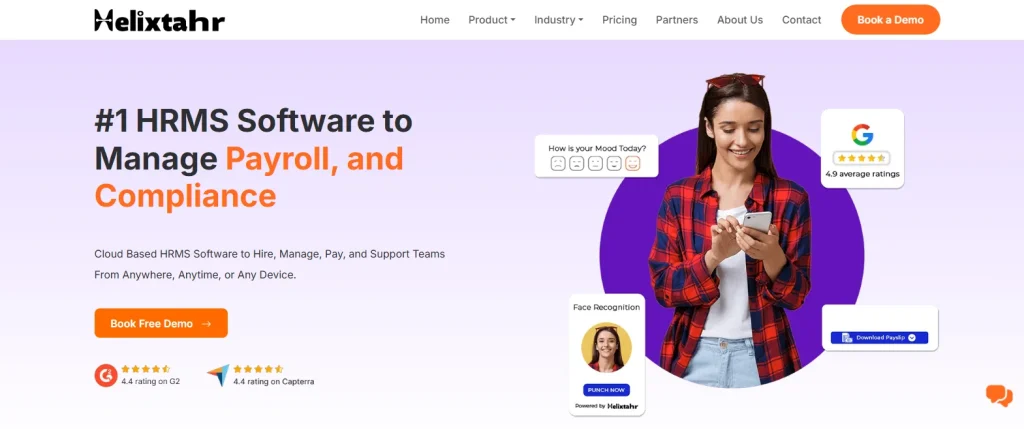
HelixtaHR is an HRMS software built specifically for Indian startups and small businesses that need to move beyond Excel — without the complexity of enterprise tools.
Most growing companies face a common problem: payroll errors, scattered attendance data, and endless leave tracking in spreadsheets. HelixtaHR solves this by bringing payroll, attendance, leave, and employee records into one simple system.
What makes HelixtaHR different is its focus on simplicity without compromise. The software doesn’t overwhelm you with features you’ll never use. Instead, it focuses on what Indian SMEs actually need — accurate payroll management software, attendance management software that syncs automatically, and a clean employee self-service portal.
The system is designed for Indian salary structures, including PF, ESIC, PT, and TDS compliance. Employees can check their attendance, apply for leave, and download payslips without asking HR — reducing daily workload significantly.
For businesses with 10 to 500 employees, HelixtaHR hits the sweet spot between functionality and ease of use.
Key Features:
- Simple and accurate payroll processing
- Attendance directly linked to payroll (no manual work)
- Customisable leave and holiday policies
- Employee self-service portal
- Clean, actionable HR reports
- Built for Indian compliance (PF, ESIC, PT, TDS)
Pros:
- Extremely easy to use — no technical training required
- Attendance-to-payroll integration saves hours every month
- Self-service portal reduces repetitive HR queries
- Built specifically for Indian payroll and compliance needs
- Clean interface with no unnecessary complexity
- Affordable pricing for small and growing teams
Cons:
- Not suitable for enterprises with 1,000+ employees needing custom workflows
- Advanced modules like recruitment and learning management are in development
Best For:
Startups, small businesses, and growing Indian companies that need a reliable, easy-to-use HRMS without enterprise-level complexity.
Why HelixtaHR Ranks #1:
Most HRMS tools either offer too little (glorified Excel) or too much (enterprise complexity at enterprise prices). HelixtaHR is purpose-built for the Indian SME — with the right features, simple UX, and pricing that makes sense. If you’re a business that wants HR to just work, this is the tool to consider.
See why HelixtaHR is ranked #1 for Indian startups and growing businesses.
Take a Free Demo →2. Keka – Best for Mid-Size Companies with Structured HR Teams
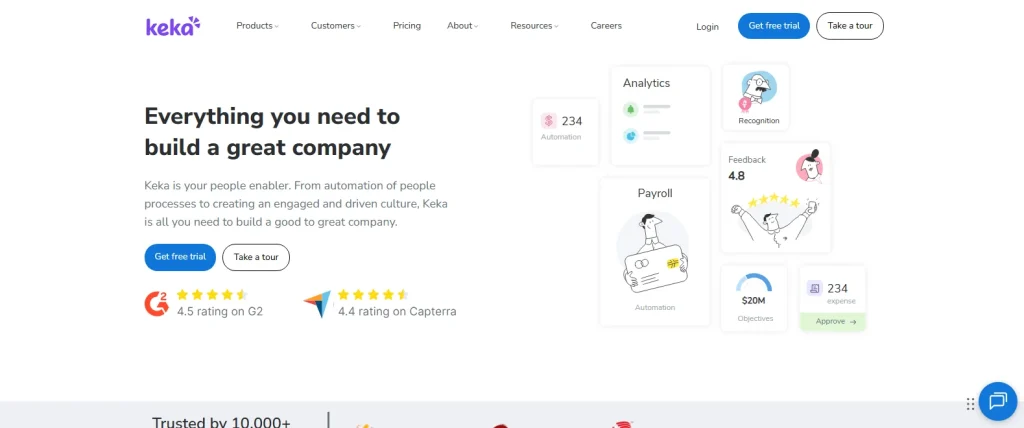
Keka is one of the most well-known HRMS platforms in India, widely used by mid-size companies. It offers robust payroll processing along with performance management, hiring, and onboarding tools.
Keka works well for organisations with dedicated HR teams and structured HR processes. The platform is feature-rich, which is a strength for larger teams but can be overwhelming for smaller businesses.
The pricing is on the higher side, and the learning curve is steeper compared to simpler tools. If you have a 5-person HR team managing 300+ employees, Keka can be a solid choice. For smaller teams, it might feel like overkill.
Key Features:
- Comprehensive payroll and salary processing
- Performance management system
- Hiring and onboarding workflows
- Expense management
- Customisable reports
Pros:
- Wide range of features beyond core HR
- Strong payroll engine with Indian compliance
- Good UI design and mobile app
Cons:
- Higher pricing — may not suit small businesses
- Feature complexity requires training
- Customer support response times vary based on plan
Best For:
Mid-size companies (100-1,000 employees) with dedicated HR teams looking for an all-in-one HRMS solution.
3. GreytHR – Best for Payroll Compliance Focus
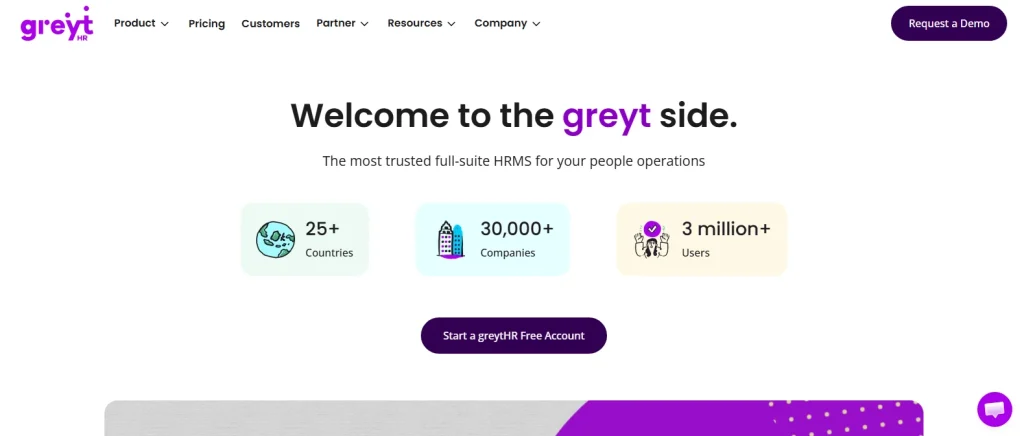
GreytHR is a trusted name in India, especially for companies that prioritise statutory compliance. It’s widely used for payroll processing, PF/ESIC management, and generating compliance reports.
The platform is reliable for core payroll tasks, but its interface feels dated compared to modern HRMS tools. Customisation options are limited, and many users report that the system can feel rigid.
If your primary concern is getting statutory compliance right, GreytHR delivers. For a more modern, flexible HR experience, you may want to explore other options.
Key Features:
- Payroll processing with strong compliance
- PF, ESIC, PT, and TDS reports
- Leave and attendance management
- Employee self-service
Pros:
- Reliable for Indian statutory compliance
- Established brand with a long track record
- Good for payroll-focused operations
Cons:
- Interface feels outdated
- Limited flexibility and customisation
- Some features feel clunky compared to newer tools
Best For:
Companies with heavy payroll compliance requirements who prioritise reliability over modern UX.
4. Zoho People – Best for Businesses Already in the Zoho Ecosystem
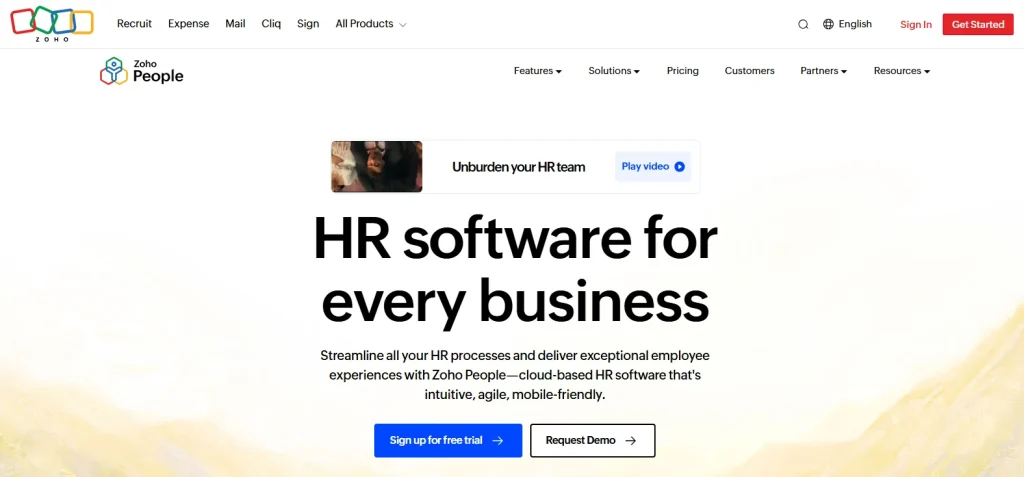
Zoho People is a cloud-based HR platform that handles core HR tasks like attendance, leave, and HR workflows. It integrates seamlessly with other Zoho products, making it ideal for companies already using Zoho CRM, Zoho Books, or Zoho Projects.
The challenge is that Zoho People’s Indian payroll capabilities are limited. You may need to integrate with Zoho Payroll separately, and even then, the experience isn’t as seamless as dedicated Indian HRMS tools.
For non-Zoho users, it might not justify switching. But if you’re already a Zoho shop, it can simplify your tech stack.
Key Features:
- Core HR management
- Attendance and leave tracking
- Workflow automation
- Integration with Zoho ecosystem
Pros:
- Great integration with Zoho products
- Affordable pricing tiers
- Workflow customisation options
Cons:
- Indian payroll support is weak as a standalone
- Not ideal if you’re not using other Zoho tools
- Can feel fragmented without integrations
Best For:
Businesses already using Zoho products who want to keep HR within the same ecosystem.
5. factoHR – Best for Mobile-First SMEs
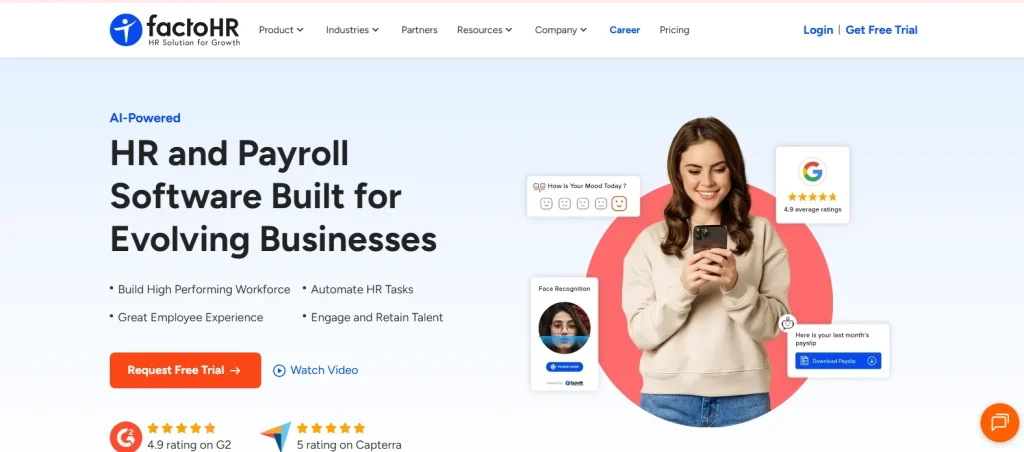
factoHR is a cloud-based HRMS designed for SMEs with a strong focus on mobile accessibility and attendance tracking. It offers a clean interface and covers payroll, attendance, and employee management.
The platform is easy to use and suitable for businesses that want a straightforward HRMS without advanced features. However, it lacks depth in areas like performance management and analytics.
Key Features:
- Attendance and leave management
- Payroll processing
- Employee self-service
- Mobile app for HR tasks
Pros:
- Mobile-friendly interface
- Simple and easy to implement
- Good for basic HR automation
Cons:
- Limited advanced features (performance, analytics)
- May outgrow the platform quickly as you scale
Best For:
Small and mid-size businesses looking for a basic, mobile-first HRMS.
6. Pocket HRMS – Best for Payroll-Focused Small Businesses
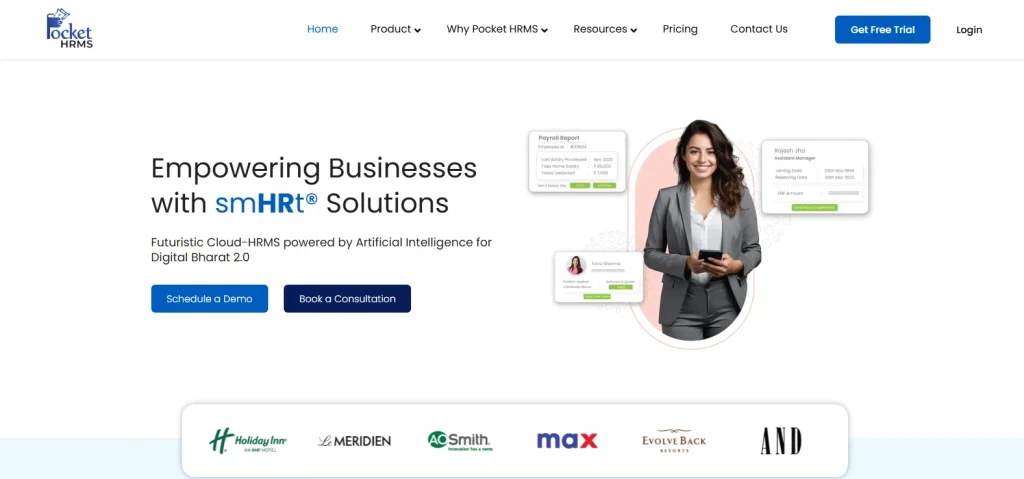
Pocket HRMS is built for small businesses that primarily need payroll and employee self-service. It covers salary processing, payslip generation, and basic HR tasks.
The platform is affordable and functional but doesn’t offer the polish or depth of more modern HRMS tools. Some users report that the interface could be more intuitive.
Key Features:
- Payroll management
- Payslip generation
- Employee self-service portal
- Leave tracking
Pros:
- Simple payroll processing
- Affordable for small teams
- Basic self-service features
Cons:
- Interface needs improvement
- Limited features beyond payroll
- Reporting could be stronger
Best For:
Small businesses that primarily need payroll and basic employee self-service.
7. HROne – Best for Mid-Size Companies with Standard HR Needs
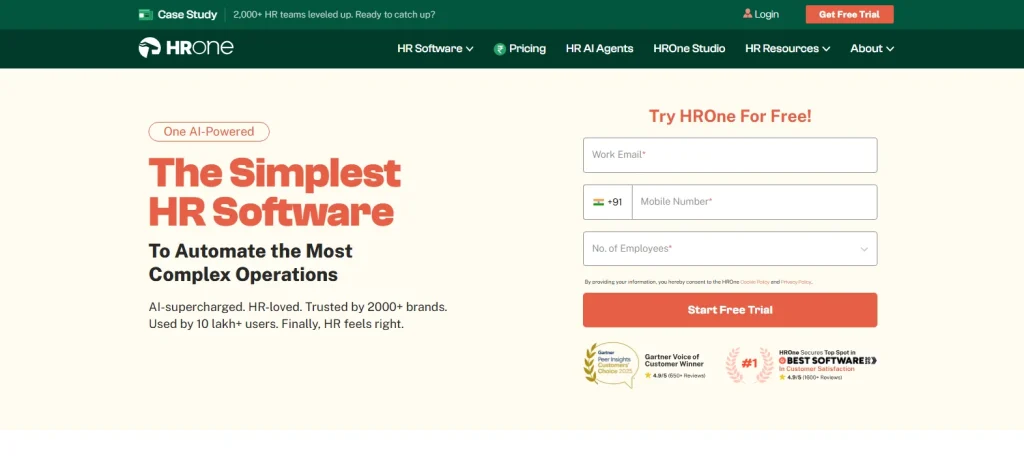
HROne offers a hire-to-retire HRMS solution for mid-size businesses. It covers payroll, attendance, performance, and employee data management.
The platform is functional and covers most HR needs, but users report limited customisation options. It’s a safe choice for mid-size teams that need standard HR features without heavy customisation.
Key Features:
- HR operations management
- Employee data management
- Payroll and attendance
- Employee self-service
Pros:
- Comprehensive HR workflows
- Employee self-service portal
- Clean interface
Cons:
- Limited customisation
- Scalability concerns for larger teams
- Integration options could be broader
Best For:
Mid-size companies looking for a standard, all-in-one HRMS solution.
8. Zimyo – Best for Startups Exploring Employee Engagement
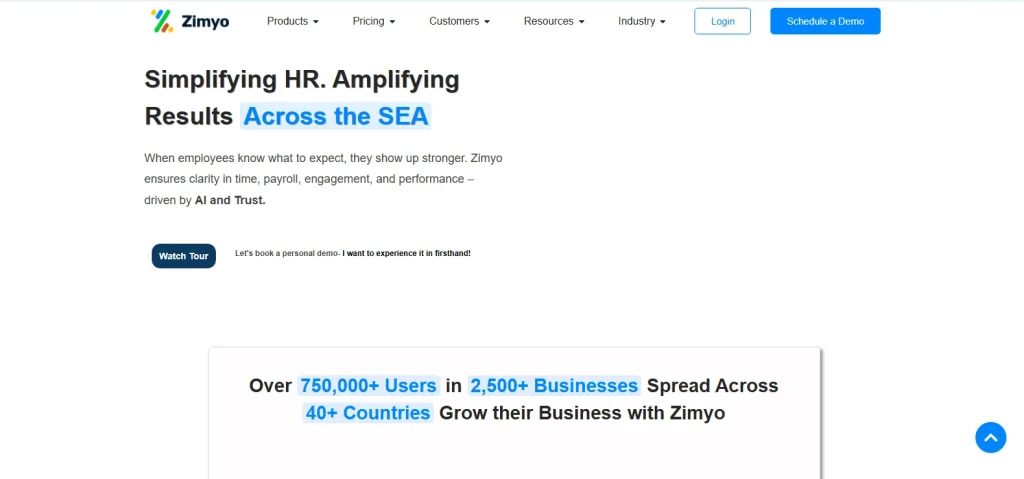
Zimyo is a newer HRMS player targeting startups and small businesses. It offers core HR features along with employee engagement tools like surveys and recognition.
The platform is user-friendly, though some users report that customer support can be inconsistent. It’s a good option for startups that want to explore engagement features early on.
Key Features:
- Payroll and attendance
- Performance management
- Employee engagement tools
- User-friendly interface
Pros:
- Modern, clean interface
- Employee engagement features included
- Startup-friendly positioning
Cons:
- Customer support experiences vary
- Some features feel underdeveloped compared to established players
Best For:
Startups that want core HR plus engagement tools in one platform.
9. Darwinbox – Best for Large Enterprises
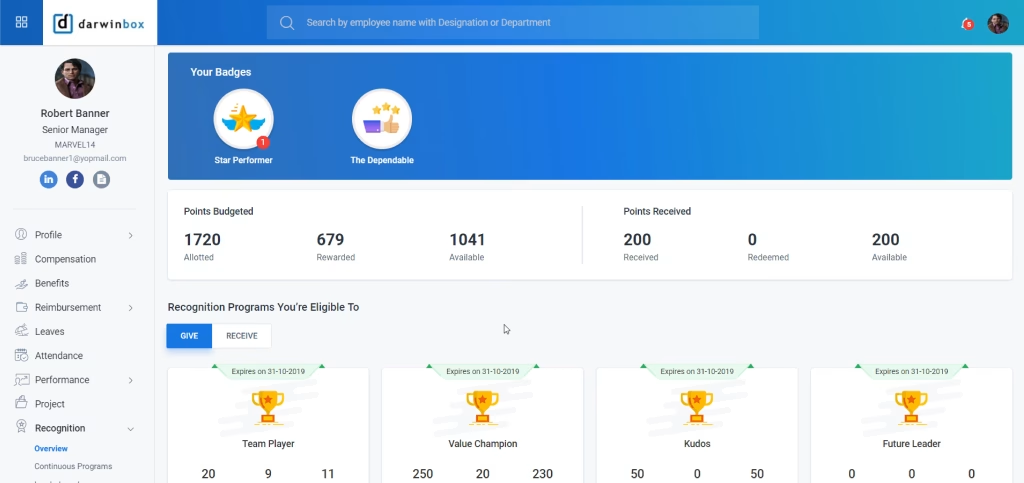
Darwinbox is an enterprise-grade HRMS used by large organisations with complex HR requirements. It offers advanced talent management, analytics, workforce planning, and custom workflows.
The platform is powerful but comes with enterprise pricing and implementation timelines. It’s not designed for small businesses — both in terms of cost and complexity.
Key Features:
- Talent management
- Advanced analytics and reporting
- Workforce planning
- Custom workflows
Pros:
- Enterprise-level features and scalability
- Strong analytics and reporting capabilities
- Suitable for complex organisations
Cons:
- High cost — not suitable for SMEs
- Long implementation and onboarding cycles
- Overkill for small and mid-size teams
Best For:
Large enterprises with 1,000+ employees and dedicated HR technology teams.
10. ZingHR – Best for Organisations with Field Workforce
ZingHR is a mobile-first HRMS focused on organisations with distributed or field-based employees. It offers geo-tagging, biometric integration, and mobile attendance features.
The platform is useful for industries like manufacturing, logistics, and retail where employees aren’t desk-based. However, pricing is on the higher side, and the system can feel complex for smaller teams.
Key Features:
- Mobile-first approach
- Geo-tagged attendance
- Employee engagement tools
- Workforce analytics
Pros:
- Strong mobile and geo-attendance features
- Good for field workforce management
- Employee engagement tools
Cons:
- Higher pricing compared to competitors
- Customisation can be complex
- Interface may feel overwhelming
Best For:
Organisations with field-based employees (logistics, manufacturing, retail).
HRMS Feature Comparison Table (2026)
| Feature | HelixtaHR | Keka | GreytHR | Zoho People | factoHR |
| Payroll (India-ready) | ✅ | ✅ | ✅ | ⚠️ (Limited) | ✅ |
| Attendance-Payroll Link | ✅ | ✅ | ✅ | ⚠️ | ✅ |
| Leave Management | ✅ | ✅ | ✅ | ✅ | ✅ |
| Employee Self-Service | ✅ | ✅ | ✅ | ✅ | ✅ |
| Statutory Compliance | ✅ | ✅ | ✅ | ⚠️ | ✅ |
| Ease of Use | ⭐⭐⭐⭐⭐ | ⭐⭐⭐ | ⭐⭐⭐ | ⭐⭐⭐⭐ | ⭐⭐⭐⭐ |
| Best for Small Business | ✅ | ⚠️ | ⚠️ | ⚠️ | ✅ |
| Best for Mid-Size | ✅ | ✅ | ✅ | ✅ | ✅ |
| Best for Enterprise | ❌ | ⚠️ | ⚠️ | ❌ | ❌ |
✅ = Strong | ⚠️ = Limited / Partial | ❌ = Not Ideal
Final Verdict: Which HRMS Should You Choose?
If you’re a startup, small business or medium business (10-200 employees):
→ HelixtaHR is the best choice. It gives you everything you need — payroll, attendance, leave, self-service — without the complexity or cost of enterprise tools.
If you’re a mid-size company with a structured HR team:
→ Consider Keka or HROne, depending on whether you need performance management and hiring features.
If your primary concern is payroll compliance:
→ GreytHR remains a reliable (if slightly dated) option.
If you’re already using Zoho products:
→ Zoho People will integrate well, but consider adding Zoho Payroll for full functionality.
If you’re a large enterprise:
→ Darwinbox is built for you — with the budget and timeline to match.
See how HelixtaHR can help you:
- Run error-free payroll in minutes
- Automate attendance tracking
- Give employees self-service access
- Stay compliant with Indian HR laws
No complex setup. No hidden fees. Just HR that works.
Ready to Simplify Your HR?
If you’re tired of juggling spreadsheets and dealing with HRMS tools that overpromise and underdeliver, it’s time to try HelixtaHR.
Request a Free Demo →Frequently Asked Questions (FAQs)
For small businesses and startups in India, HelixtaHR is among the best options. It offers simple payroll, attendance tracking, and employee self-service — all designed for Indian compliance without the complexity of enterprise tools. Other good options include factoHR and Pocket HRMS.
HRMS software pricing in India typically ranges from ₹20 to ₹150 per employee per month, depending on the features included. Some vendors charge setup fees separately. HelixtaHR offers transparent, affordable pricing suited for small and growing businesses.
Yes, cloud-based HRMS is better for most businesses. It offers access from anywhere, automatic backups, regular updates, and lower upfront costs. Desktop-based systems are outdated and risk data loss due to hardware failures.
Key features to look for include:
Payroll processing with Indian compliance (PF, ESIC, PT, TDS)
Attendance and leave management
Employee self-service portal
Clean reports and dashboards
Mobile accessibility
Reliable customer support
Not all HRMS tools handle Indian compliance well. Platforms like HelixtaHR, Keka, and GreytHR are built for Indian salary structures and support PF, ESIC, Professional Tax, and TDS. Always verify this before choosing a tool.
Implementation timelines vary. Simple tools like HelixtaHR can be set up within a few days to a week. Enterprise platforms like Darwinbox may take several weeks to months depending on customisation requirements.
Switching is easier than you think. Most HRMS vendors assist with data migration — importing employee records, leave balances, and payroll history from Excel. HelixtaHR offers guided onboarding to ensure a smooth transition.