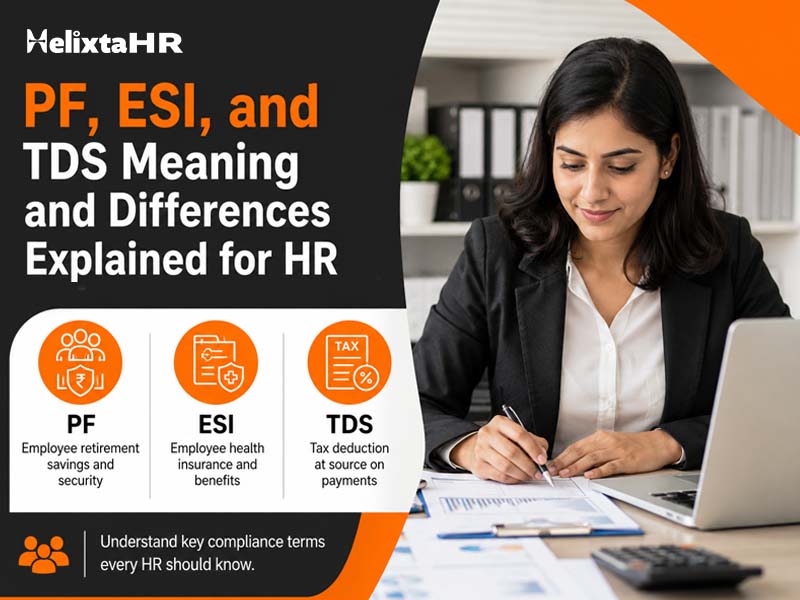
If you’ve ever looked at a payslip and wondered why different deductions show up every month, you’re not alone. PF, ESI and TDS often get lumped together as “statutory deductions,” but each one serves a completely different purpose. For HR professionals, understanding what each deduction actually does isn’t optional — it’s the difference between running clean payroll and dealing with penalties, confused employees, or a messy audit later.
What are PF, ESI, PT and TDS?
Still juggling HR across spreadsheets and emails?
HelixTAHR brings payroll, leave, attendance, and employee records onto one platform – built for indian businesses, compliant by default.
These deductions cover retirement savings, medical benefits, a state tax, and income tax — and mixing them up is easier than it sounds. Here’s what each one actually means.
Provident Fund (PF)
PF (Provident Fund) is a retirement savings scheme managed by the Employees’ Provident Fund Organization (EPFO). Both the employee and employer contribute a percentage of the basic salary every month, and the amount builds up over time with interest.
Key features of PF:
- Managed and regulated by EPFO
- Contribution comes from both employee and employer
- Earns interest on the accumulated balance
- Can be withdrawn during retirement, job loss, medical emergencies, or specific situations like a home purchase
Employees’ State Insurance (ESI)
ESI is a health and social security scheme run by the Employees’ State Insurance Corporation (ESIC). It applies to employees below a certain salary threshold and covers medical needs beyond just a doctor’s visit.
Key features:
- Applicable to employees under a defined salary limit
- Covers medical treatment, maternity, and sickness benefits
- Extends to disability and dependent benefits in eligible cases
- Requires timely contribution and eligibility checks by the employer
Ready to Automate Your HR Operations?
Join 200+ SMEs and Enterprises scaling with HelixTAHR. Get a personalized walkthrough of our Payroll, Attendance, and Performance modules.
No credit card required • Setup in under 24 hours
Tax Deducted at Source (TDS)
TDS is simply income tax, collected in smaller monthly instalments instead of one large payment at year-end. The employer calculates it based on the employee’s projected annual income and applicable exemptions.
Key features of TDS:
- Based on projected annual taxable income
- Adjusted for eligible exemptions and deductions
- Deducted monthly and deposited with the Income Tax Department
- Form 16 issued to employees at the end of the financial year
Difference Between PF, ESI and TDS
On a payslip, all deductions sit next to each other and can look fairly similar. In reality, they don’t overlap at all — each one answers a different need, from long-term savings to immediate tax collection. Here we have given the differences between PF, ESI and TDS to help you understand them better:
| Deduction | What It’s For | Managed By |
| PF | Retirement savings | EPFO |
| ESI | Medical and health benefits | ESIC |
| TDS | Income tax collection | Income Tax Department |
Why Is It Important for HR Professionals
Payroll compliance isn’t just an administrative task — it directly affects how much employees trust the company and how well it holds up during an audit. Understanding these deductions helps HR teams in a few practical ways. Here are the reasons why HR professionals must understand PF, ESI and TDS:
1. Process Salaries Accurately
Once HR understands how each deduction is calculated, salary processing stops being a guessing game. There’s no need for last-minute corrections after payslips have already gone out, which saves both time and awkward follow-up emails.
2. Avoid Penalties and Interest
Penalties and interest apply not only when there is late filing or incorrect filing of PF, ESI, and TDS but also when there is no filing. Knowledge of all these rules would ensure that there will be no penalties or interest charged for any mistakes that the company could have easily avoided.
3. Handle Employee Questions with Confidence
Employees tend to raise questions regarding various kinds of deductions very often, including when a new employee receives their pay slip for the first time, containing deductions such as PF and PT. This allows answering all the queries of the employees without saying “it’s just like that”.
4. Stay Audit-Ready
The statutory audit can take place with minimal notice and it would be highly problematic for everyone to gather all the information at the last moment. HR professionals who know all the rules about deductions maintain better record keeping throughout the year.
5. Build Employee Trust
It is important to keep your salary slips free from any errors. Any mistake in deductions would immediately raise doubts in the mind of the employee regarding the company’s trustworthiness.
6. Adapt to Regulatory Changes
PF rates, PT slabs, and TDS exemptions don’t stay fixed forever — they change periodically, sometimes with little warning. HR professionals who understand the fundamentals can adapt Payroll processes quickly instead of being caught off guard when a rule updates.
Common Mistakes Happen While Managing Payroll
Even well-run HR teams slip up here, usually not out of carelessness but because manual tracking leaves too much room for error.
- Missing PF or ESI payment deadlines
- Applying the wrong Professional Tax slab for an employee’s state
- Incorrect TDS calculation due to outdated tax slabs
- Marking an employee as ESI-eligible or exempt incorrectly
- Delayed filing of statutory returns
- Not updating payroll after a regulatory change
- Relying on manual, spreadsheet-based calculations
How HR & Payroll Software Can Simplify Payroll Compliance
This is precisely where manual effort starts to show its limits, and where good payroll software earns its place. Instead of tracking every rule change by hand, HR teams can let the system handle it.
- Automatically calculates PF, ESI and TDS based on current rules
- Applies the correct PT slab depending on employee location
- Updates TDS calculations as tax rules or exemptions change
- Tracks statutory due dates so nothing gets missed
- Generates payslips and compliance reports instantly
- Keeps clean records ready for audits at any time
- Cuts down manual errors that come from spreadsheet-based payroll
Still have questions about HelixTAHR?
Whether you’re a small startup or a large enterprise, our HR experts are ready to help you find the right plan for your team.
Final Words
PF, ESI and TDS aren’t just numbers on a payslip — they represent real financial security, healthcare access, and tax compliance for every employee on your payroll. Getting them right consistently is hard to manage by hand, especially as a team grows or spreads across multiple states.
That’s precisely what HelixtaHR has been designed for, as it will help you calculate PF, ESI and TDS without any errors so your HR team does not have to spend their time rectifying mistakes but instead concentrate on things that need their personal attention. If the compliance process still seems like a struggle for you every month, then perhaps HelixtaHR can do that job for you.