Post In:
- Attendance Management


HelixtaHR is India's leading HRMS software for payroll, leave, attendance and employee management — smart, AI-first HR technology designed to simplify work for businesses.

Contact Info
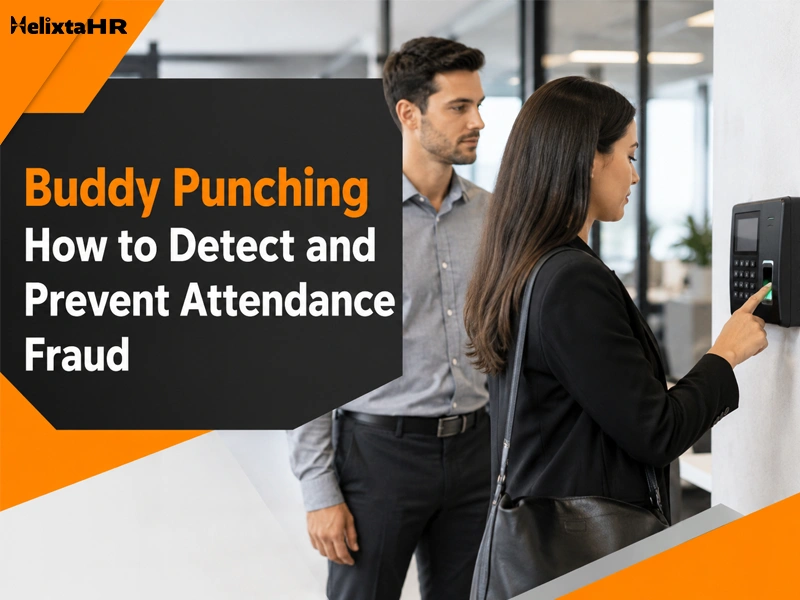
Picture a warehouse on a Monday morning. The 9 AM shift looks perfect on the sheet, every name ticked. Then the scanner goes down for an hour and suddenly eleven people aren’t where the record says they are. Nobody planned a scam. One person punched in for a friend stuck in traffic and the favour kept getting repeated. This guide goes through how buddy punching shows up, what it costs a company and what actually helps.
Helix AI, built into HelixtaHR
Stop searching HR screens. Just ask Helix AI.
Helix AI is the HR assistant inside HelixtaHR. Ask a question, review the details, confirm, and everyday HR work gets done in one conversation.
The act of buddy punching is an instance where someone signs in on behalf of another who is not physically present in the workplace. This can take various forms depending on the system in use in that office. The common forms include fingerprints, borrowed ID cards, common passwords, and even signing in using another cell phone.
It rarely begins with bad intent. A friend is late, so you cover once. Next week someone covers you. Within a few months it’s just how the place works and nobody remembers who started it.
A single odd entry tells you very little. People do get stuck in traffic and scanners do misread. It’s the same pair of names turning up together again and again that deserves a conversation.
Payroll takes the first hit. The numbers usually quoted come from Nucleus Research and the American Payroll Association. Buddy punching is estimated to be at about 2.2 percent of gross payroll, with almost three out of four businesses experiencing some kind of loss. The above statistics are largely based on studies in America, hence they should only be taken as a rough guide in India.
Still, do the maths for a team you know. Take 100 people at ₹30,000 a month on average, which comes to about ₹3.6 crore in annual payroll. Two point two percent of that is nearly ₹8 lakh. No report ever shows that amount, because it’s spread thinly across thousands of salary lines.
The last point gets forgotten most often. An HR executive who spends two days a month sorting out attendance arguments is a cost too.
Nothing here is foolproof by itself. Most offices that solve this end up using two or three of these together.
Fingerprint and face scanning link attendance to the body, not to an object someone can hand over. Fingerprint machines have been standard in Indian offices for years and they do work. They also mean buying hardware, queueing at 9 AM with forty people behind you and waiting for data to sync with whatever HR system sits behind it, which doesn’t always happen on time. Face scanning removes the touching and most of the queue.
Mobile check-in records the location for each time punch, but is good for those who won’t be walking by a scanner since it doesn’t identify who is using the phone. The only thing a GPS point tells you is that the phone was there, nothing else.
Geo-fencing places a boundary around the office or plant, and check-ins happen only within the boundary. It means that checking in from one’s home or the chai stall next to the gate is simply no longer possible.
The system will search for patterns such as when two people always beat each other up within a second from each other, when someone always checks into two places one hour from each other, or even identical patterns that match all the way down to the minute for weeks.
A policy won’t fix this alone, but without one, nothing else sticks.
Do:
Find out why it’s happening, because long commutes and rigid start times push people toward shortcuts
Don’t:
And if one senior person gets a pass, everyone knows about it within a week
Nobody goes through 500 punches each morning and reads them one after another. The computer does this and it does not start getting distracted by the third hundred. Within several weeks, the computer will have established what is usual for everybody on all shifts and sites and then it will be able to highlight exceptions. Two employees that clock in within seconds from each other on the same device will be spotted, as well as somebody who clocked in miles away from where he was an hour ago.
What it hands back is a list of things to look at, not a verdict. HR still talks to the people involved, checks the context and makes the call. The real benefit is timing. A pattern gets noticed in a week or two, instead of surfacing in an audit eight months later.
HelixtaHR’s Common Device Facial Recognition Attendance Management software is built for exactly this problem. One shared Android or iOS device sits at the entrance and acts as the attendance terminal, so there’s no biometric machine to buy, install or repair. Each employee logs in to the HelixtaHR app on it once and registers their face. After that, they just look at the camera. The system confirms who it is before it records anything, which means a borrowed card or a shared PIN is of no use to anyone.
A few practical points:
It fits the way people already work, without adding another machine for IT to look after.
It takes a couple of weeks for it to learn what a typical day looks like for every individual, every shift, every site, and therefore identify the entries that deviate. It will flag two colleagues who clock in within seconds of each other every single day at the same machine, or an unusual log-off location for someone miles away from their previous log-on location.
What comes out of the system is a list of suspicious activities, not an indictment. HR gets in touch with the concerned individuals, evaluates the context, and draws its own conclusion.
