
Usually, invoices come to clients’ inboxes long after the deal is made. However, the image created by an invoice stays in the memory of a potential client much longer than the deal itself. Business owners do not mind spending money on logos, professionally designed websites and social media pages like Instagram but still sending out invoices that look like they have been created using Notepad in 2009. It is a bizarre loophole since an invoice is also a marketing document regardless of the fact whether someone considers it such.
The invoice template design affects the image built in other spheres negatively. Let us discuss why custom invoice templates are so important, how invoicing tools help brand your invoices effortlessly and what elements should be included into a properly designed invoice.
What Is a Custom Invoice Template?
Still juggling HR across spreadsheets and emails?
HelixTAHR brings payroll, leave, attendance, and employee records onto one platform – built for indian businesses, compliant by default.
It is a bill designed using the identity of your organization and not just any standard invoice copied from Google. Your logo is displayed at the top, your organization’s colors are used in the header design, your contact information is precisely where you expect the customer to look for them, and it all makes sense coming from the same company that had provided the proposal and the email. Imagine yourself comparing this invoice with a standard black and white design that could have been made by any organization in the world, and it would be clear from the beginning what the difference is all about.
This is exactly why invoicing software has caught on the way it has. Most tools today let you set this up once, without any design background at all and reuse it indefinitely.
Why Branding Your Invoices Actually Matters
Branding does not refer to slapping a logo and slogan on your document. It refers to the familiarity the client feels each and every time they have something to do with your business, which includes the invoice too. Since the invoice is usually generated at the end of a transaction, it gives an impression of professionalism just at the point where your client decides to give your business another chance.
In effect, an invoice that is branded conveys the message that they will be transacting with a legitimate business entity and not someone who just became a freelancer yesterday. The branded invoice also makes things less confusing because clients receive lots of emails per day and it becomes easier to mistake one for spam.
Keep this up consistently, invoice after invoice and you build something harder to fake: recognition. Recognition, given enough time, turns into trust.
A few concrete reasons this pays off:
- Professional credibility — smaller or newer businesses benefit most here, since a polished invoice signals you’re not winging it
- Faster recognition — clients juggling invoices from several vendors can spot yours at a glance, just from the colours and logo
- Fewer payment delays — a clear, branded invoice with obvious instructions tends to get paid quicker than a confusing one
- Free marketing — every invoice becomes a small, repeated reminder of who you are, even inside a document that’s purely administrative
Role of Invoicing Software in Building Brand Identity
Try designing invoices by hand in Word every month and the problem shows up fast — no two ever look quite the same and small mistakes creep in without anyone noticing. Invoicing software fixes this by giving you a template you set up once and reuse for every client, every single time. Beyond the design side, these tools catch calculation errors, keep formatting consistent and store records neatly for whenever tax season or an audit comes around. Most platforms let you drop in your logo, lock in your brand colours, tweak the layout and even automate recurring invoices for clients you bill month after month.
The upshot is fairly simple — less time spent reformatting documents, more time spent actually running the business.
Key Elements Every Branded Invoice Should Include
Before sitting down to build your own template, it helps to know what actually needs to be on it.
- Business logo and name — top of the page, first thing a client sees
- Brand colours and fonts — matched to your website or letterhead, not picked at random
- Invoice number and date — needed for tracking and record-keeping
- Client details — full name, address and contact info, so there’s no confusion about who’s being billed
- Itemised charges — a clear breakdown of what’s being billed, at what rate, for how much
- Payment terms and due date — stated plainly, so payment doesn’t get delayed over ambiguity
- Accepted payment methods — bank details, UPI, payment links, whatever applies
- Contact information — somewhere for the client to reach out if something looks off
Miss a few of these and you’re not just hurting the design — you’re creating openings for disputes and delayed payments down the line.
How an Invoice Management System Simplifies Branding at Scale
When a company begins to produce numerous bills per month, it is impractical to manually put logos on them. This can be solved through an invoice management system whereby the company keeps a template that is automatically branded regardless of the member of staff who produces the bill and irrespective of the number of bills that have been produced within a given week. Each client gets a similar invoice. The advantage of this is that all the client information is automatically entered into the invoices through stored data.
For a business that’s scaling, this kind of consistency isn’t a nice-to-have. It’s what keeps the brand looking put-together even as volume climbs.
Custom Invoice Template Examples You Can Use
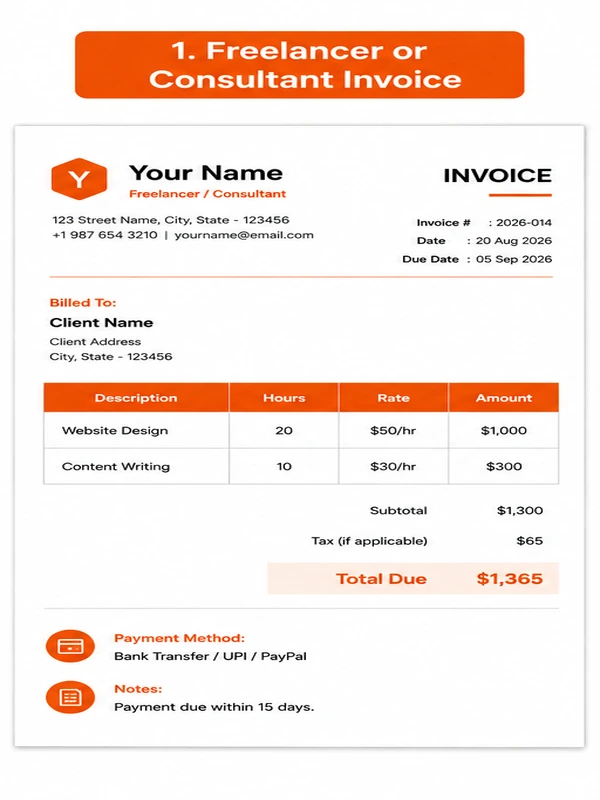
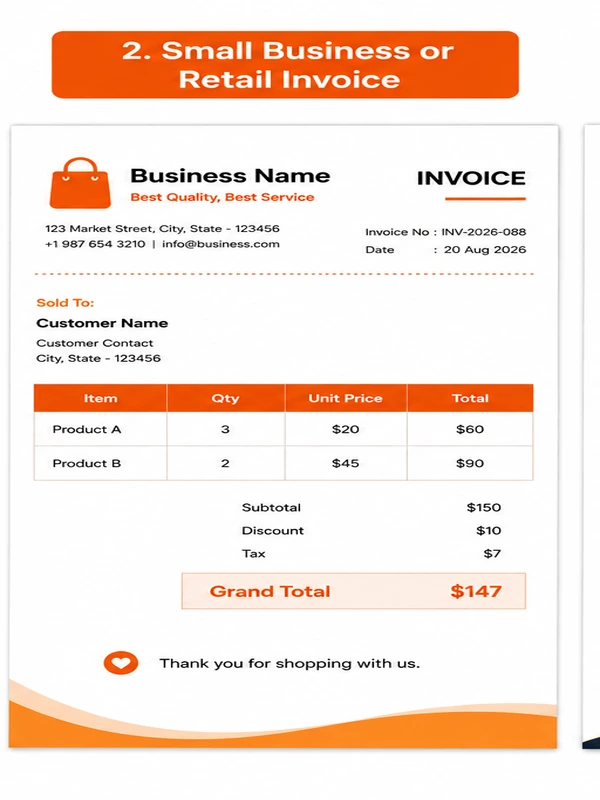
Here are three simple structures, each suited to a different kind of business. Treat them as starting points; any invoicing software will let you adapt the colours, fonts and layout from here.
Template 1: Freelancer or Consultant Invoice
Template 2: Small Business or Retail Invoice
Template 3: Service-Based Agency Invoice
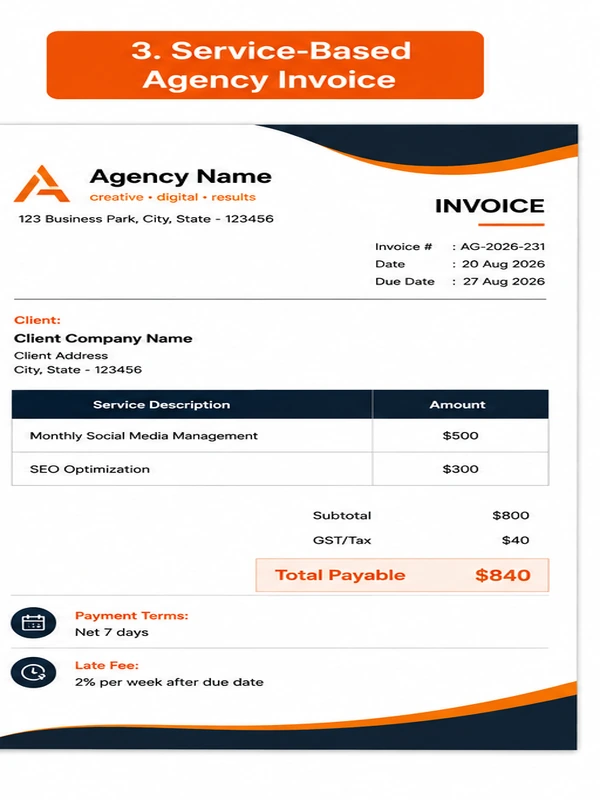
Swap in your own colours, fonts and spacing once you’ve picked the structure that fits your business.
Branded Invoices vs Generic Invoices: A Quick Comparison
| Factor | Branded Invoice | Generic Invoice |
| Client trust | Higher, thanks to a recognisable identity | Lower, can look unofficial |
| Payment speed | Usually faster, less room for confusion | Often delayed by unclear formatting |
| Professional image | Consistent and deliberate | Forgettable, sometimes sloppy |
| Brand recall | Reinforces who you are | Leaves no lasting impression |
Common Mistakes Businesses Make With Invoice Branding
Even well-meaning attempts at branding go wrong sometimes. A few patterns show up again and again:
- Overcrowding the design. Too many colours or graphics and the invoice starts looking amateurish rather than polished.
- Ignoring mobile readability. A lot of clients open invoices on their phone first. If the layout breaks on a small screen, that’s a problem.
- Switching templates too often. Jumping between formats confuses clients and undoes whatever brand recognition you’d built up.
- Skipping essential fields. No invoice number, no due date, no tax breakup, these aren’t small omissions. They cause real accounting headaches down the line.
Fix these and the invoice stays both good-looking and functionally sound.
How Invoicing Ties Into Broader Business Systems
Invoicing rarely stands alone once a business grows past a certain size. More companies now lean toward an invoice management system that talks to their accounting, inventory and sometimes even HR setup. That overlap matters for businesses already running HR software and payroll software, since vendor payments, employee reimbursements and client invoices tend to intersect in the same reports. Get these systems talking to each other and reconciling accounts stops being a monthly headache, plus you cut down on duplicate or missing entries.
It’s really just part of a bigger shift: businesses moving away from a pile of disconnected tools toward one system that actually works together.
Still have questions about HelixTAHR?
Whether you’re a small startup or a large enterprise, our HR experts are ready to help you find the right plan for your team.
Conclusion
A branded invoice does more than ask for payment. It’s a small but telling sign of how seriously your business treats every client it works with. Putting effort into custom invoice templates, backed by dependable invoicing software, builds trust, speeds up payments and keeps your brand consistent with every single transaction you send out. Businesses juggling both client billing and employee-related work often find it easier to go with a platform that brings invoicing, HR software and payroll software together instead of managing three separate systems.
HelixtaHR is built for exactly that kind of setup, helping businesses handle HR, payroll and the administrative load that comes with them in one structured place, so there’s more room to focus on growth and less time lost to repetitive paperwork. Branding shapes how clients see you at every touchpoint and an invoice, routine as it seems, deserves the same care as your logo or your website.