Post In:
- HR Guide


HelixtaHR is India's leading HRMS software for payroll, leave, attendance and employee management — smart, AI-first HR technology designed to simplify work for businesses.

Contact Info
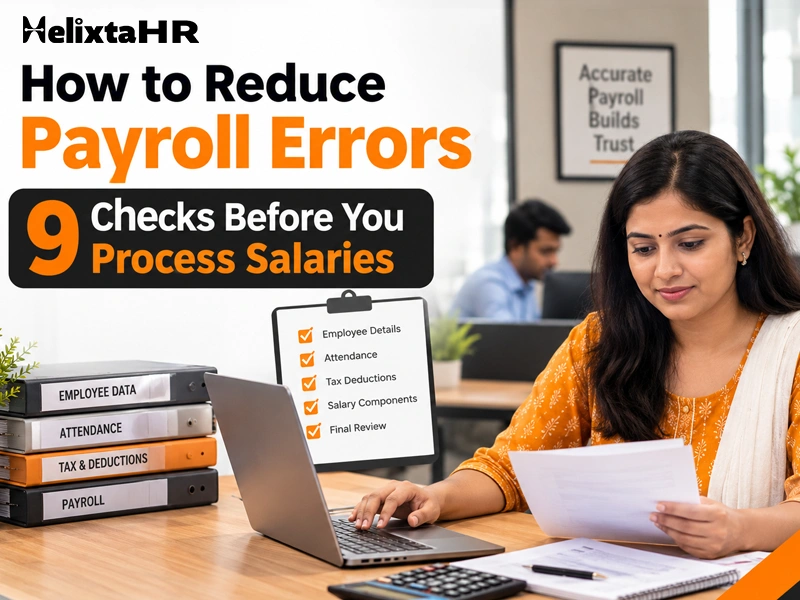
Ask most HR executives what they dread around the 28th of the month and salary processing comes up quickly. One wrong figure in a payslip is enough to start a flood of calls and emails. Payroll errors are rarely dramatic. A leave that never got updated or an old salary figure that nobody replaced, can leave a dozen employees wondering why their pay looks different. A short set of checks before you click “process” prevents most of this.
Helix AI, built into HelixtaHR
Stop searching HR screens. Just ask Helix AI.
Helix AI is the HR assistant inside HelixtaHR. Ask a question, review the details, confirm, and everyday HR work gets done in one conversation.
Most payroll errors don’t come from one big failure. They build up from small gaps that nobody notices during a busy month-end. Three of them turn up again and again in Indian companies. Here is how each one happens.
All salary calculations begin with attendance, hence one mistake can go a long way. For instance, when an employee goes on leave for half a day on the 18th, but the approval of attendance takes place after two days, with the employee marked as having attended the whole day.
Payroll pays for time not worked or reduces payroll for time that was worked. When attendance, leave and payroll live in separate sheets, gaps like this are almost guaranteed. It remains the most common cause of payroll errors.
The statutory PF wage ceiling is Rs. 15,000 per month. Some organizations contribute based on the said amount while some others contribute based on the entire basic pay. Both are okay so long as the organization specifies this in its policy and treats everybody the same. Problems arise when new entrants are treated differently from veteran employees.
Arrears sit outside the regular monthly run, which is exactly why they get forgotten. A revision letter is signed on the 20th but backdated to April, payroll closes on the 25th and nobody informs the payroll team. The employee spots a short payment a month or two later, by which time the amount has grown. Missed arrears are a quiet kind of payroll error. They stay hidden until someone complains.
Manual data entry adds its own risk. Old bank accounts, tax declarations that were never filed and duplicate employee IDs are all common. Exits processed in a hurry cause trouble as well. Changes in regulations like the introduction of new tax brackets or new definitions for wages could take an organization by surprise. Each one in itself seems to be trivial, but collectively it explains why so many months end with corrections.
Consider it as a door which the payroll department must pass through every month. It takes only a few minutes to process each check and not hours. Process these in sequence, since the initial checks will provide input for processing subsequent checks. When done on a consistent basis, most payroll errors will be caught.
Begin here since everything else depends on this. Cross-check the attendance sheet with payroll data, one by one. Deal with outstanding leaves and process them before the cut-off date. Compare LOP with leave balance. Only then lock down the attendance cycle.
It is at the people movement where there can be problems in payroll. Ensure that all newly recruited employees have the correct joining dates and pay scale. In case of exiting employees, check the last date of working and if the full and final settlement is complete. Transferred staff should be mapped to the correct location and entity. A wrong status update here can create payroll errors that repeat for months.
Open the salary structure of anyone who received an increment or promotion this month. Make sure the new pay applies from the date mentioned in the letter, not the date it was entered. Allowances and deductions should match the offer terms. Then compare gross pay with last month’s total. If something jumped without a reason, find out why.
Go through how PF is applied across the company. Is it on the ₹15,000 ceiling or on actual basic? Whatever your policy says, it should hold for every employee in the same category. Verify the employee share, the employer share and each UAN. Clear PF rules remove a big chunk of compliance-related payroll errors.
These deductions change by state and by wage level, so they need a fresh look each month. ESI applies only to employees under the wage limit and some staff may have crossed it after a hike. Professional tax slabs also differ from one work location to another. Check that each employee sits in the right bracket. A small mistake here can turn into a penalty later.
Look past the regular salary and list every one-time payment due. Pending arrears from revisions or backdated joinings come first. Then add bonuses, incentives and approved reimbursements. Check how each item is taxed. Without a fixed step for this, one-time payments are the easiest thing to miss.
TDS depends on up-to-date declarations. Confirm which tax regime each employee has chosen. Check whether investment proofs have been submitted and recorded. For anyone whose pay changed a lot, review the projected tax for the year. Getting TDS right early avoids a painful deduction in the last quarter.
A wrong account number means a failed payment and an angry employee. Verify the account numbers and IFSC codes for all new members and those who have switched their bank accounts. The next step is to generate a variance report comparing this month with the previous one. Inquire about each and every sharp variation in the net salary amount or number of employees.
Approval is not only the duty of the person who processes the payroll. Ensure you forward the payroll to your finance or HR head before distribution. Include the variance and exception report so they will know where to look. It is important that this approval process is recorded. It is a simple control, yet it stops many payroll errors cold.
The true cost of payroll mistakes goes beyond just getting the payment wrong on the paycheck. It touches the employees, regulations and the availability of your staff. In most cases, the damage exceeds the initial error. Three areas feel it most.
Salary is personal. When someone is underpaid or sees an odd deduction, they worry first and ask questions second. HR then spends days answering queries and issuing corrections. If it happens twice, employees begin to doubt the whole department. Trust lost over payroll errors takes a long time to earn back.
Mistakes in PF, ESI, TDS or professional tax can bring notices and financial penalties. Late or incorrect PF payments may attract interest and damages. Audits also look closely at filings that don’t match payroll records. Correcting old returns takes far more effort than getting them right the first time. For most companies, this is the costliest side of payroll errors.
Every error needs a re-run, a revised payslip and sometimes an off-cycle payment. That time comes straight out of work HR and finance should be doing. Month-end starts to feel like firefighting. Recovering an overpayment from an employee is awkward and slow. Fewer payroll errors mean more hours for work that actually moves the business.
Checks by humans can be helpful, but they require alertness on the part of the person doing them. When there are many individuals on the payroll, the most alert of humans will overlook trends. AI systems operate over your process and observe the incoming information. They raise alerts before salaries are processed, not after.
AI compares attendance, leave and payroll records without anyone opening three files side by side. It notices when an employee’s LOP days don’t match their leave balance. Sudden changes in salary, deductions or net pay get flagged too. So do missing bank details and duplicate entries. Your team reviews a short list of exceptions and skips the row-by-row hunt.
AI also understands how the average month appears for your organization. In case there is any deviation from this normal pattern, it sends an alert. This might include something out of the ordinary about the PF deduction, omission of an arrear entry, or crossing of the statutory limit by one of the employees. Such alerts help you review faster and also much more efficiently.
HelixtaHR provides a combined solution for attendance, leaves and payroll. Information flows from one module to the other without the need to enter anything multiple times. Compliance with statutory requirements is integrated into the process and AI-driven alerts ensure inconsistencies are caught before approval of the payroll run. This ensures fewer errors and quicker completion of the payroll process.
If you want payroll that you can trust every month, take a look at HelixtaHR’s payroll software built for Indian businesses.
Payroll errors are common, but they are not a given. Most start with an attendance gap, a wrong PF wage ceiling or a missed arrear. A nine-point checklist, a variance report and a second approval will stop the majority of them. Add AI-based flagging and payroll becomes more accurate, more compliant and a lot less stressful.
