Post In:
- HR Software Guide


HelixtaHR is India's leading HRMS software for payroll, leave, attendance and employee management — smart, AI-first HR technology designed to simplify work for businesses.

Contact Info
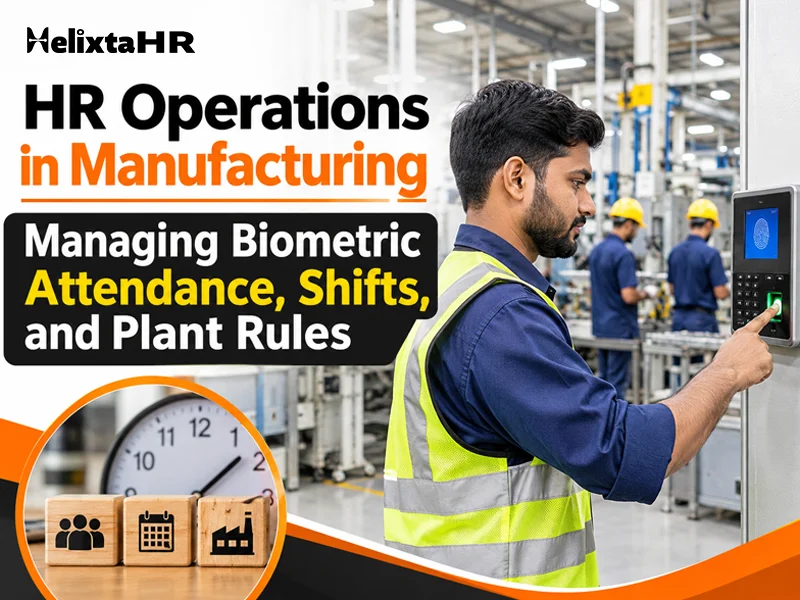
Imagine it’s 6:05 on a Tuesday morning. The first shift is on the floor, the biometric machine has logged a few hundred punches, and the night shift supervisor is still sending overtime hours over WhatsApp. Payroll closes in three days.
That’s an ordinary day in plant HR. Manufacturing HR isn’t just maintaining employee files. It’s coordinating people across shifts, production lines and departments, while every attendance entry quietly turns into a salary figure. HR software for manufacturing connects attendance, shifts, employee information, and payroll, so those pieces stop living in separate registers.
Office HR is mostly about one building, one schedule and a fairly predictable day. Manufacturing HR management isn’t. Here’s what changes on the plant side:
Each of those adds a layer. Put them together and one wrong entry can ripple through a shift roster, an overtime sheet and a salary run.
That’s why factory workforce management needs accurate, centralised information. If the shift register says one thing and the attendance log says another, someone has to settle it by hand. Usually at the worst possible time.
Biometric attendance gives plants a reliable way to record check-ins and check-outs without relying on handwritten registers. A good biometric attendance system does more than log a punch. It helps HR:
Depending on operational needs, some plants also use facial recognition or mobile attendance. A gate-based terminal suits fixed shifts. Mobile options suit supervisors or staff moving between locations.
Here’s the practical catch. A biometric punch records an event. It doesn’t resolve problems. Devices fail. Fingers get dirty or worn. People forget. Factory attendance management works only when HR has a process for device failures, missed punches and exceptions, not just a machine at the gate.
In a plant, the shift roster is the backbone. Production runs on it. So does payroll. With the help of efficient employee shift management, you can cover:
Last-minute changes are where things slip. A worker swaps a shift. A supervisor extends a line. Nobody updates the roster.
Take a simple case. An employee works two hours beyond their scheduled shift. Before HR can pay that as overtime, it needs verified working hours and an approval on record. Without both, the entry becomes a dispute later. That’s the heart of manufacturing payroll management: the figure on the payslip is only as good as the hours and approvals behind it.
Rules only work if people know them. Write them down, communicate them and apply them the same way in every department. Here are the ones HR touches daily:
Attendance and punctuality– Define shift reporting times, grace periods and the missed-punch procedure. If the grace period is ten minutes on one line and fifteen on another, expect arguments.
Safety and workplace conduct- Employees need to know the safety procedures, protective equipment requirements and plant access rules. HR doesn’t run the safety program, but it keeps the acknowledgements and training records.
Overtime and weekly rest– Set clear approval procedures, working-hour limits and weekly rest arrangements. Overtime that nobody approved is the quickest route to a payroll dispute.
Leave and absence management– Cover how leave is requested, how absences are reported and how department-level availability is checked. A line can’t run short-staffed because three leave requests were approved in isolation.
Employee and contractor records– Keep employee information accurate and maintain the relevant contractor workforce records. Plants with mixed workforces can’t afford fuzzy lines here.
Manufacturing HR problems are specific. They show up at shift change, not in a strategy meeting.
Most of these trace back to one thing: data living in different places. Fix that and half the list shrinks.
A smart HR software for manufacturing supports how a plant actually runs, not just who’s on the employee list. Look for:
The test is simple. Can it handle a rotating roster, a missed punch at 2 a.m. and an overtime approval, then carry all of it into payroll without anyone retyping? If it only stores records, it’s a filing cabinet with a login.
Here’s what the official sources say. Check them against your own establishment.
One caution matters here. Requirements can differ by the appropriate government, the category of establishment and state rules. Don’t treat one state’s factory rules as universal for every manufacturing unit in India. Confirm what applies to your plant with your compliance advisor.
HelixtaHR is an AI-powered HRMS that lets manufacturing businesses manage workforce operations on one platform. It covers:
For a plant, the payoff looks like this: less manual attendance reconciliation, better visibility into attendance and shifts, more organised payroll inputs and fewer repetitive HR queries. That leaves HR more time for workforce planning and plant operations.
A manufacturing plant runs on coordinated shifts and people. Structured attendance, shift and payroll processes keep that coordination from breaking at the seams. HR software for manufacturing brings those operations together, cuts manual work and gives HR a clearer view of who’s where.
HelixtaHR is built for that kind of setup, connecting attendance, shifts and payroll with AI assistance on top. And the connection can start earlier. Plants that link hiring through recruitment software to their wider HR operations carry clean employee data from the first day of onboarding. Get that foundation right and every shift after it runs a little smoother. It’s a system that manages attendance, shifts, leave, overtime, employee records and payroll for plant-based workforces, so these functions work from one set of data. It records check-ins and check-outs against employee IDs and shifts, and helps HR spot late arrivals, early departures and missed punches. HR still needs a process for device failures and exceptions. Maintain a current shift roster, record shift changes as they happen and compare actual attendance against assigned timings. Shift management software makes this far easier than registers. By recording actual working hours against scheduled shifts and keeping approval records. Verified hours and documented approvals should be in place before overtime goes into payroll. Yes. Attendance, overtime and loss-of-pay data can feed directly into salary calculations. HR should still review payroll inputs and outputs before finalising salaries.
Frequently Asked Questions
