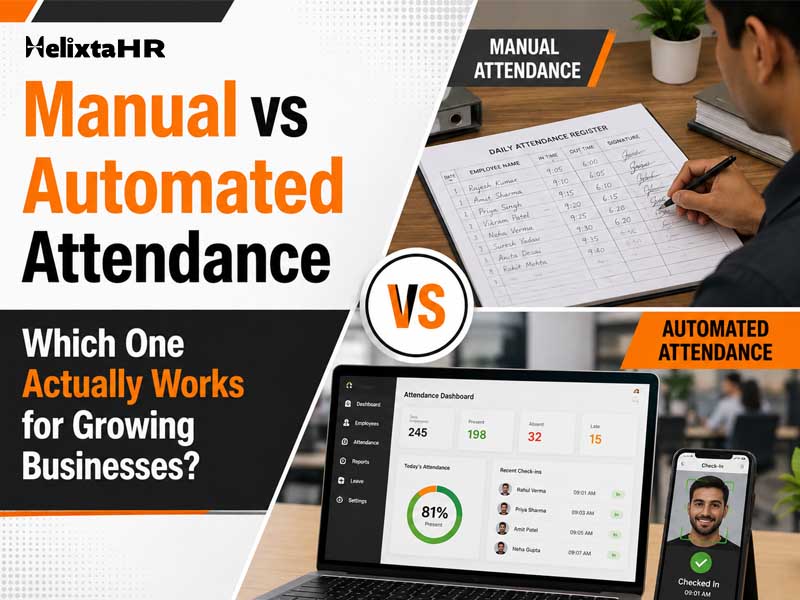
Most companies start out tracking attendance with a register or a spreadsheet and for a while, it works fine. The trouble begins once the team grows, shifts multiply and someone in HR ends up spending half the month untangling numbers that don’t quite add up. This article compares manual and automated attendance in plain terms, so the decision is based on what actually happens on the ground, not just on what feels familiar.
What is Manual Attendance?
Still juggling HR across spreadsheets and emails?
HelixTAHR brings payroll, leave, attendance, and employee records onto one platform – built for indian businesses, compliant by default.
Manual attendance uses a physical attendance book or sign-in sheet, wherein the employees have to indicate their time in and time out by themselves – usually checked by a superior at the end of each day or each week.
- Simple to start — no software or hardware needed, which makes it an easy default for very small teams
- Prone to human error — entries get missed, times get mismarked and there’s no real way to catch a mistake until payroll time
- Easy to manipulate — buddy punching and inflated hours are hard to spot when the system relies entirely on trust
- Time-consuming at scale — reconciling registers across departments or shifts eats up hours every single month
While manual attendance will function quite well for a small business that has only a few employees working in one location, it becomes inefficient rather quickly whenever the number of employees increases
What Is Automated Attendance?
Automated attendance tracks employee check-ins and check-outs through a system — biometric devices, mobile apps or geo-fencing — with the data flowing directly into payroll and HR Software records without anyone typing it in by hand.
- Accurate by design — biometric or app-based check-ins remove the guesswork and make tampering far harder
- Real-time visibility — managers can see who’s in, who’s late and who’s absent without waiting for a register to be compiled
- Scales without added effort — adding new employees or locations doesn’t multiply the manual workload the way a paper register does
- Directly feeds into payroll – Since the attendance figures are directly linked to salaries, it becomes unnecessary to perform any form of reconciliation
Automation is suitable in all types of environments – office, factory, field and hybrid workforces, depending on the method of check-in for each.
Key Differences of Manual vs Automated Attendance
The gap between the two becomes clearest once you look at what happens as a business grows. Here we have listed a few key differences between Manual attendance and Automated attendance management software to help you understand which one is better for your business:
| Factor | Manual attendance | Automated attendance |
| Accuracy | Depends on people remembering to mark entries correctly | Captures the exact time automatically, no reliance on memory |
| Fraud risk | Buddy punching and inflated hours are common | Biometric or geo-fenced check-ins make faking attendance far harder |
| Time spent reconciling | Needs manual compiling and cross-checking before payroll | Data is already payroll-ready, no reconciliation needed |
| Scalability | Gets harder to manage with every new employee | Handles growth without added administrative load |
| Audit readiness | Registers are harder to produce accurately during a compliance check | Keeps a clean, timestamped record that’s easy to retrieve |
None of this means manual attendance is always the wrong choice — it depends entirely on the size and complexity of the business.
Which One Should Your Business Choose?
For a very small team working out of a single location, a manual register might still get the job done without causing major problems. There’s little complexity to manage and the cost of adopting software might not be justified just yet.
Once a company reaches the point where it goes to multi-shifts, or it has several branches or has over twenty people working for it, then manual systems become too expensive to maintain. There are always more payroll disagreements, while Human Resources has more time spent reconciling rather than doing anything productive.
Automated attendance removes most of that friction. It doesn’t just save time — it also protects the business from the kind of disputes and errors that manual systems are prone to once volume increases.
Why Attendance Method Matters for Payroll and Compliance
Whichever method a business uses, attendance data eventually feeds into payroll and that’s where accuracy becomes non-negotiable. Salary calculations, leave deductions and loss-of-pay figures all depend on attendance being correct and any gap in tracking tends to surface as a dispute right when payroll is being processed.
This is where compliance comes in. The labour laws in India necessitate accurate attendance data to be available, which is not likely to fare well in an audit if stored in a traditional paper register. This will eliminate the need for any kind of reconciliation at month end with regard to payroll through automation.
Still have questions about HelixTAHR?
Whether you’re a small startup or a large enterprise, our HR experts are ready to help you find the right plan for your team.
Final Thoughts
Manual attendance isn’t inherently a bad choice — it’s simply a starting point that most businesses eventually outgrow. The real question isn’t whether manual tracking works at all, but whether it’s still working well enough for where the business stands today.
Automated attendance solves the problems that manual systems were never built to handle at scale — accuracy, fraud prevention and a direct connection to payroll and compliance reporting. For any business managing more than a handful of employees, especially across shifts or locations, switching to an automated system tends to pay for itself quickly, simply by removing the hours HR used to spend fixing avoidable mistakes every single month.